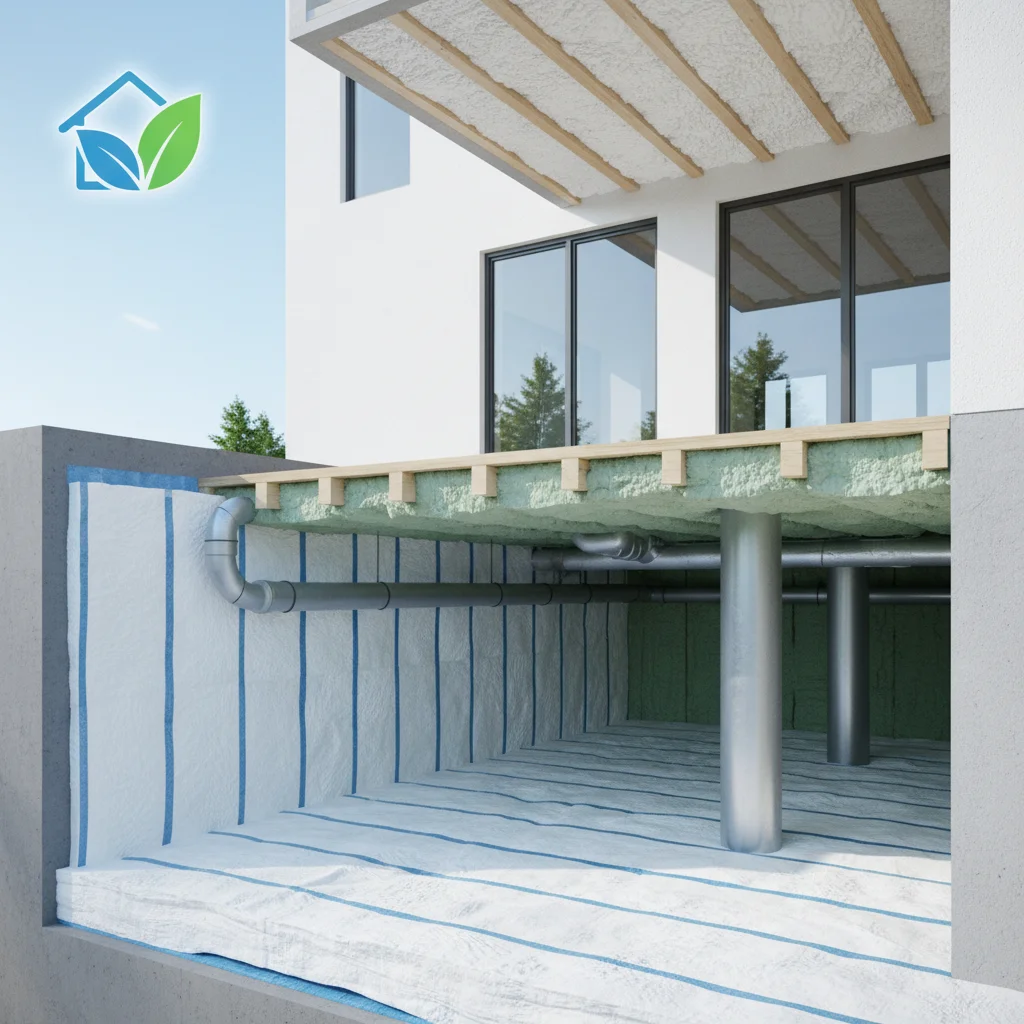
Homeowners lose 15-25% of their heating and cooling energy through uninsulated crawl spaces, translating to $300-$600 in wasted utility bills annually. And in 2026, federal tax credits and state rebates can offset 30-50% of installation costs, making crawl space insulation one of the fastest-payback energy upgrades available. But crawl space insulation costs vary dramatically—from $1.50 per square foot for basic fiberglass batts to $7 per square foot for closed-cell spray foam—and not all materials qualify for rebates.
What Does Crawl Space Insulation Cost in 2026?
Crawl space insulation costs $1,500 to $15,000 for a 1,200-square-foot home in 2026, depending on material type and labor complexity. Fiberglass batts cost $1.50-$3.50 per square foot installed. Spray foam costs $3-$7 per square foot. Rigid foam boards cost $2-$4.50 per square foot. Labor accounts for 40-60% of total cost. Professional installation takes 1-3 days for most homes.
Fiberglass batts remain the cheapest option at $1.50-$3.50 per square foot installed, covering a 1,200-square-foot crawl space for $1,800-$4,200. So a homeowner in Sacramento installing R-19 fiberglass batts pays $2,400-$3,000 for materials and labor. But fiberglass loses R-value when exposed to moisture, making it a poor choice for vented crawl spaces in humid climates.
Spray foam costs $3-$7 per square foot installed, totaling $3,600-$8,400 for a 1,200-square-foot crawl space. Closed-cell spray foam provides R-6 to R-7 per inch and acts as a vapor barrier, preventing moisture intrusion. And open-cell spray foam costs $3-$4.50 per square foot but requires a separate vapor barrier. So closed-cell spray foam dominates installations in flood-prone areas and high-moisture climates.
Rigid foam boards cost $2-$4.50 per square foot installed, totaling $2,400-$5,400 for a 1,200-square-foot crawl space. Extruded polystyrene (XPS) boards deliver R-5 per inch and resist moisture better than fiberglass. But installation requires precise cutting and sealing, adding 20-30% to labor costs compared to batts.
Labor costs account for 40-60% of total installation expenses. Professional installers charge $1-$3 per square foot for fiberglass batts, $2-$4 per square foot for spray foam, and $1.50-$2.50 per square foot for rigid foam boards. And crawl spaces with limited access, pest infestations, or mold remediation needs add $500-$2,000 to labor costs.
Which Crawl Space Insulation Types Qualify for Rebates?
Spray foam insulation qualifies for federal tax credits and state rebates in 2026 when installed as part of a whole-home energy efficiency upgrade. Fiberglass batts qualify only if they meet minimum R-value thresholds set by state programs. Rigid foam boards qualify in most states when used for foundation or rim joist insulation. Rebate amounts range from $200 to $1,600 depending on material type and total project scope.
The federal Energy Efficient Home Improvement Credit (Section 25C) ended for property placed in service after December 31, 2025 (IRS FS-2025-05). Federal tax credits for this work have ended, but state, local and utility rebates may still apply; check what is available at your address with the DuloCore rebate calculator. So a homeowner spending $6,000 on closed-cell spray foam claims a $1,200 credit. But standalone crawl space insulation projects don't qualify—insulation must be part of a larger weatherization effort including air sealing, duct sealing, or HVAC upgrades.
California's TECH Clean California program offers rebates of $200-$400 for crawl space insulation when paired with heat pump installations. And the program requires insulation to meet or exceed R-19 for floors and R-10 for foundation walls. But fiberglass batts below R-19 don't qualify, pushing homeowners toward spray foam or rigid foam options.
Energy Upgrade California rebates cover crawl space insulation at $0.08-$0.15 per square foot when installed as part of a comprehensive home energy assessment. So a 1,200-square-foot crawl space receives $96-$180 in rebates. But rebates require third-party verification through a Home Energy Score assessment, adding $300-$500 to upfront costs.
Utility rebates from Pacific Gas & Electric (PG&E), Southern California Edison (SCE), and San Diego Gas & Electric (SDG&E) provide $0.10-$0.25 per square foot for crawl space insulation meeting Energy Star guidelines. And rebates stack with federal tax credits, delivering combined savings of 35-50% on total installation costs.
How Long Does Crawl Space Insulation Last Before Replacement?
Spray foam insulation lasts 80-100 years without replacement when installed correctly. Fiberglass batts last 15-25 years before sagging, moisture damage, or pest infiltration degrades R-value. Rigid foam boards last 50-100 years when protected from UV exposure and physical damage. Lifespan depends on moisture control, vapor barrier integrity, and crawl space ventilation strategy.
Closed-cell spray foam delivers the longest lifespan at 80-100 years because it resists moisture, doesn't sag, and creates an air-tight seal. So a homeowner installing closed-cell foam in 2026 won't need replacement until 2106. But spray foam degrades when exposed to UV light, requiring crawl spaces to remain dark and enclosed.
Fiberglass batts last 15-25 years before performance declines. And moisture exposure reduces lifespan to 10-15 years in vented crawl spaces or flood-prone areas. Batts sag over time, creating air gaps that reduce effective R-value by 20-40%. But fiberglass remains the cheapest option for dry, well-ventilated crawl spaces with minimal moisture risk.
Rigid foam boards last 50-100 years when installed with proper vapor barriers and sealed joints. Extruded polystyrene (XPS) and polyisocyanurate (polyiso) boards resist moisture and compression better than fiberglass. But improper installation leaves air gaps that reduce R-value by 15-30%, negating long-term performance gains.
Moisture control determines insulation lifespan more than material choice. Crawl spaces with standing water, high humidity above 60%, or inadequate vapor barriers experience insulation failure within 5-10 years regardless of material type. And mold growth on fiberglass batts forces premature replacement, adding $2,000-$5,000 to total lifecycle costs.
What Rebate Programs Can You Claim for Crawl Space Insulation?
Homeowners claim federal tax credits, state rebates, and utility incentives for crawl space insulation in 2026. The federal Energy Efficient Home Improvement Credit (Section 25C) ended for property placed in service after December 31, 2025 (IRS FS-2025-05). California's Energy Upgrade California program offers $200-$1,600 in rebates depending on project scope. Utility rebates from PG&E, SCE, and SDG&E provide $0.10-$0.25 per square foot. Programs stack but require third-party energy assessments and minimum R-value compliance.
The federal Energy Efficient Home Improvement Credit (Section 25C) ended for property placed in service after December 31, 2025 (IRS FS-2025-05). So a homeowner spending $8,000 on spray foam insulation and air sealing claims a $1,200 credit (the annual cap). Form 5695 only covers qualifying work completed by December 31, 2025 and claimed on a 2025 return; the federal 25C and 25D credits ended after that date (IRS FS-2025-05).
Energy Upgrade California rebates range from $200 to $1,600 depending on project scope and verified energy savings. Basic insulation-only projects receive $200-$400. But whole-home upgrades combining insulation, air sealing, and HVAC improvements qualify for $800-$1,600. And rebates require a pre-installation Home Energy Score assessment costing $300-$500, which some programs cover.
Utility rebates from California's major energy providers stack with federal and state programs. PG&E offers $0.10-$0.25 per square foot for crawl space insulation meeting Energy Star guidelines. SCE provides $200-$600 per home for insulation upgrades verified through their Home Upgrade Program. And SDG&E offers tiered rebates of $250-$500 based on total energy savings achieved.
Local programs add another layer of savings. The Bay Area Regional Energy Network (BayREN) provides up to $4,000 in rebates for comprehensive home energy upgrades including crawl space insulation. And programs require licensed contractors, third-party inspections, and proof of R-value compliance to release funds.
How Much Can You Save With Federal Tax Credits and Local Rebates?
Homeowners save 30-50% on crawl space insulation costs by stacking federal tax credits, state rebates, and utility incentives in 2026. The federal Energy Efficient Home Improvement Credit (Section 25C) ended for property placed in service after December 31, 2025 (IRS FS-2025-05). State rebates add $200-$1,600. Utility rebates contribute $0.10-$0.25 per square foot. A $6,000 spray foam installation yields $1,200 federal credit, $400 state rebate, and $300 utility rebate, totaling $1,900 in savings—32% of project cost.
The federal Energy Efficient Home Improvement Credit (Section 25C) ended for property placed in service after December 31, 2025 (IRS FS-2025-05). So a homeowner installing $6,000 in closed-cell spray foam claims a $1,200 credit. But homeowners spending $3,000 claim only $900. And the credit applies only when insulation is installed alongside other qualifying energy upgrades like air sealing or duct improvements.
State rebates from Energy Upgrade California add $200-$1,600 depending on verified energy savings. Basic insulation projects receive $200-$400. But comprehensive upgrades combining insulation, air sealing, and HVAC improvements qualify for $800-$1,600. So a homeowner completing a whole-home energy upgrade receives $1,200 in state rebates plus the $1,200 federal credit, totaling $2,400 in savings.
Utility rebates contribute $120-$300 for a 1,200-square-foot crawl space at $0.10-$0.25 per square foot. And rebates process within 6-8 weeks of project completion, providing faster cash flow than tax credits claimed during the following year's filing season.
Combined savings reach 30-50% of total installation costs when all programs stack. A $6,000 spray foam installation receives $1,200 federal credit, $400 state rebate, and $300 utility rebate, totaling $1,900 in savings—32% of project cost. But a $12,000 comprehensive upgrade receives $1,200 federal credit, $1,200 state rebate, and $600 utility rebate, totaling $3,000 in savings—25% of project cost.
Use our free rebate calculator to estimate your total savings based on zip code, project scope, and insulation type. The calculator aggregates federal, state, and utility programs into a single estimate, accounting for income limits, rebate caps, and program expiration dates.
Crawl Space Insulation Cost: DIY vs. Professional Installation
DIY crawl space insulation costs $0.80-$2 per square foot for materials alone, saving 40-60% compared to professional installation. Professional installation costs $1.50-$7 per square foot including labor. DIY fiberglass batt projects take 8-16 hours for a 1,200-square-foot crawl space. But spray foam requires professional equipment and certification, making DIY installation impractical. Rebate programs often require licensed contractor installation and third-party verification, disqualifying DIY projects.
DIY fiberglass batt installation costs $960-$2,400 for a 1,200-square-foot crawl space, covering materials only. R-19 batts cost $0.80-$1.20 per square foot, vapor barriers add $0.15-$0.30 per square foot, and fasteners cost $0.05-$0.10 per square foot. So total material cost reaches $1-$1.60 per square foot. But homeowners spend 8-16 hours cutting, fitting, and securing batts, and improper installation leaves air gaps that reduce effective R-value by 20-40%.
Professional fiberglass installation costs $1.50-$3.50 per square foot, totaling $1,800-$4,200 for a 1,200-square-foot crawl space. And professionals complete installation in 1-2 days with guaranteed R-value performance. But homeowners save $840-$1,800 by choosing DIY installation.
Spray foam installation requires professional equipment costing $5,000-$15,000 and certification from manufacturers like Icynene or Demilec. So DIY spray foam isn't practical for one-time projects. Professional spray foam installation costs $3-$7 per square foot, totaling $3,600-$8,400 for a 1,200-square-foot crawl space. And closed-cell spray foam delivers R-6 to R-7 per inch with a lifetime warranty when installed by certified contractors.
Rebate eligibility favors professional installation. Federal IRA credits require licensed contractor installation for projects claiming more than $600 in credits. Energy Upgrade California mandates third-party energy assessments and contractor verification for all rebate projects. And utility rebates from PG&E, SCE, and SDG&E require contractor invoices and proof of R-value compliance. So DIY projects forfeit $500-$2,000 in rebates, erasing most cost savings.
Moisture control and vapor barrier installation determine long-term performance more than insulation material. Professional installers seal rim joists, install vapor barriers, and address drainage issues that DIY homeowners often miss. And improper moisture control causes insulation failure within 5-10 years, requiring replacement costing $1,500-$8,000.
Official Sources
- IRS Energy Incentives for Individuals — Federal tax credit information for home energy improvements (note: the federal 25C and 25D credits ended for projects completed after December 31, 2025)
- DOE Energy Saver: Insulation — Department of Energy guidance on insulation types, R-values, and rebate programs
- DSIRE USA — Database of state incentives for renewables and efficiency
Related Reading: Learn more about Crawl Space Insulation Guide and Crawl Space Insulation Rebates.
Frequently Asked Questions
How much does crawl space insulation cost?
Crawl space insulation costs $1,500 to $15,000 for a 1,200-square-foot home in 2026, depending on material type and labor complexity. Fiberglass batts cost $1.50-$3.50 per square foot installed. Spray foam costs $3-$7 per square foot. Rigid foam boards cost $2-$4.50 per square foot. Labor accounts for 40-60% of total cost. And professional installation takes 1-3 days for most homes, with crawl spaces requiring mold remediation or pest control adding $500-$2,000 to total cost.
What is the average cost of crawl space insulation per square foot?
Crawl space insulation averages $1.50-$7 per square foot installed in 2026. Fiberglass batts cost $1.50-$3.50 per square foot. Closed-cell spray foam costs $5-$7 per square foot. Open-cell spray foam costs $3-$4.50 per square foot. Rigid foam boards cost $2-$4.50 per square foot. Material choice accounts for 40-50% of per-square-foot cost, with labor making up the remaining 50-60%. And crawl spaces with limited access or moisture issues add $0.50-$2 per square foot to baseline costs.
Does crawl space insulation qualify for tax credits or rebates?
The federal Energy Efficient Home Improvement Credit (Section 25C) ended for property placed in service after December 31, 2025 (IRS FS-2025-05). State rebates through Energy Upgrade California provide $200-$1,600 depending on project scope. Utility rebates from PG&E, SCE, and SDG&E offer $0.10-$0.25 per square foot for Energy Star-compliant installations. But standalone crawl space insulation projects don't qualify for federal credits—insulation must accompany air sealing, duct improvements, or HVAC upgrades. And programs require licensed contractor installation and third-party energy assessments to release funds.
How long does it take to install crawl space insulation?
Professional crawl space insulation installation takes 1-3 days for a 1,200-square-foot home in 2026. Fiberglass batt installation takes 1-2 days. Spray foam installation takes 1 day for application plus 24-48 hours for curing. Rigid foam board installation takes 2-3 days including cutting, fitting, and sealing joints. DIY fiberglass installation takes 8-16 hours spread across 2-3 days. And crawl spaces requiring mold remediation, moisture control, or pest removal add 1-3 days to total project timeline before insulation begins.
Is crawl space insulation worth the cost?
Crawl space insulation delivers payback periods of 3-7 years through reduced heating and cooling costs in 2026. Homeowners save $300-$600 annually on utility bills after insulating crawl spaces. Federal tax credits and state rebates offset 30-50% of installation costs, shortening payback to 2-4 years. Spray foam insulation lasts 80-100 years, delivering lifetime savings of $24,000-$60,000. And homes with insulated crawl spaces sell for 2-5% more than comparable homes with uninsulated crawl spaces, adding $8,000-$20,000 to resale value on a $400,000 home.
Ready to save on crawl space insulation? Use our free rebate calculator to discover federal tax credits, state rebates, and utility incentives available in your area. Get instant estimates based on your zip code and project scope—no email required.
Last updated: April 14, 2026. Reviewed by the DuloCore Editorial Team. About our authors.
Check your California insulation rebate eligibility — see the programs you qualify for and the dollar amounts on our California insulation rebate finder.