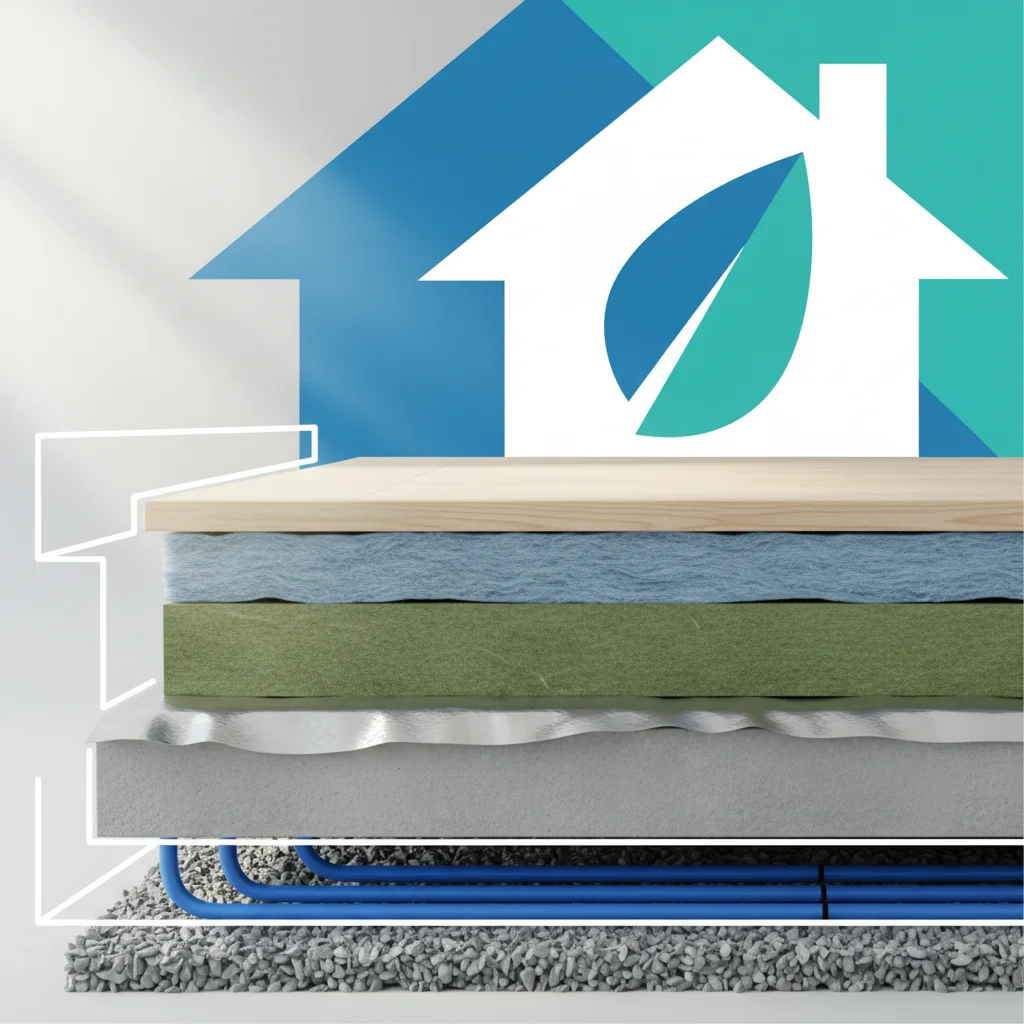
Homeowners waste an average of $460 annually through uninsulated floors above crawl spaces and unconditioned basements. That's $4,600 over a decade — enough to fund the entire insulation retrofit and still pocket savings. The federal Energy Efficient Home Improvement Credit (Section 25C) ended for property placed in service after December 31, 2025 (IRS FS-2025-05). Federal tax credits for this work have ended, but state, local and utility rebates may still apply; check what is available at your address with the DuloCore rebate calculator.
What Are the Rebate-Eligible Floor Insulation Specifications and How Do They Affect Cost?
Floor insulation installed in 2026 qualifies for federal tax credits when it meets DOE-specified R-values of R-25 or higher in climate zones 4-8, and R-19 in zones 1-3. Rebate-eligible products cost $1.80-$3.20 per square foot installed, with spray foam at the high end and fiberglass batts at the low end. Certified installers add $0.40-$0.80 per square foot for compliant air-sealing work.
The R-value directly determines both rebate eligibility and material cost. R-30 spray foam costs $3.20 per square foot but delivers a 30% federal tax credit worth $0.96 per square foot. R-19 fiberglass batts cost $1.80 per square foot with the same 30% credit worth $0.54 per square foot. So the net difference shrinks from $1.40 to $0.86 per square foot after credits.
But the R-value threshold changes by climate zone. Zone 7 properties in northern Montana require R-38 floor insulation to qualify for utility rebates averaging $850, while Zone 3 properties in coastal California meet rebate standards at R-19 and receive smaller utility incentives of $300-$450. Climate zone designation determines both the minimum investment and maximum return.
And incorrect specification voids rebate eligibility entirely. Installing R-19 in a Zone 6 property disqualifies the homeowner from federal credits and state programs, leaving them with full retail cost of $2,160 for 1,200 square feet. Installing R-25 in the same property drops net cost to $1,512 after the 30% federal credit (this federal credit ended for property placed in service after December 31, 2025) and opens access to state programs worth an additional $400-$600.
How Does Insulation Efficiency Rating Impact Your Total Floor Insulation Investment?
Insulation efficiency rating measures thermal resistance per dollar spent, with R-value per dollar ranging from R-3.2 for fiberglass batts to R-6.8 for closed-cell spray foam. Higher efficiency ratings reduce installation square footage requirements by 30-50% in retrofit scenarios, dropping labor costs from $1,200 to $600-$840 for identical thermal performance across 1,200 square feet.
A homeowner in climate zone 5 needs R-30 floor insulation. Fiberglass batts deliver R-3.7 per inch at $0.48 per square foot, requiring 8.1 inches of thickness. Closed-cell spray foam delivers R-6.5 per inch at $2.40 per square foot, requiring just 4.6 inches. The fiberglass option costs $576 in materials plus $960 in labor for joist cavity work. The spray foam option costs $2,880 in materials plus $480 in labor for faster application.
But the efficiency rating determines eligible rebate amounts. DOE Home Efficiency Rebates in 2026 provide $1,600 for whole-home energy reductions of 20-34%. Spray foam installations typically achieve 28% reductions and qualify for the full $1,600. Fiberglass installations typically achieve 18% reductions and qualify for the lower $800 tier. So the spray foam net cost drops to $1,760 while fiberglass net cost lands at $736.
And efficiency ratings affect lifespan economics. Spray foam lasts 80+ years without settling or R-value degradation. Fiberglass settles 15-20% over 25 years, dropping effective R-value from R-30 to R-24-R-25.5. Homeowners who install fiberglass face a second retrofit around year 30, adding another $1,536 in inflation-adjusted costs. Spray foam delivers 80 years of performance for a single installation.
"Insulation that settles or degrades loses its ability to stop air movement, which accounts for 40% of winter heat loss in homes with crawl spaces." — U.S. Department of Energy
Which Climate Zones Benefit Most From Floor Insulation, and What's the Cost Difference?
Climate zones 6-8 deliver floor insulation payback periods of 4.2-6.8 years, while zones 1-3 require 12-18 years for identical installations due to reduced heating degree days. Zone 7 homeowners save $680 annually with R-30 floor insulation costing $3,840 installed, while Zone 2 homeowners save $240 annually with R-19 insulation costing $2,160 installed.
The cost difference stems from both material requirements and energy savings potential. Zone 7 requires R-38 insulation to meet code and qualify for utility rebates, pushing material costs to $4,560 before labor. Zone 2 requires only R-13 to meet code, with material costs of $1,560. But Zone 7 utility rebates average $1,200 compared to $300 in Zone 2, narrowing the net cost gap from $3,000 to $2,460.
And heating fuel type amplifies the climate zone effect. Zone 6 homeowners using propane heat at $3.80 per gallon save $840 annually with R-30 floor insulation. Zone 6 homeowners using natural gas at $1.20 per therm save $420 annually with identical insulation. So the propane household reaches payback in 4.6 years while the gas household needs 9.1 years.
But cold-climate installations unlock additional rebate stacking. A Zone 7 homeowner installing R-38 spray foam qualifies for the 30% federal tax credit ($1,368), state weatherization grants ($800-$1,200), and utility performance rebates ($600-$1,400). Total rebates reach $2,768-$3,968, dropping net cost from $4,560 to $592-$1,792. Zone 2 homeowners access only the federal credit, dropping net cost from $2,160 to $1,512.
Or put differently: cold-climate homeowners pay less out of pocket and save more annually, creating a double advantage that justifies premium materials. Warm-climate homeowners face higher net costs and lower annual savings, making budget materials the rational choice.
How Does Floor Insulation Compare in Cost and Performance to Alternative Foundation Solutions?
Floor insulation costs $1.80-$3.20 per square foot installed, compared to $4.50-$7.20 per square foot for basement wall insulation and $8-$12 per square foot for crawl space encapsulation. Floor insulation delivers 85-92% of the thermal performance of crawl space encapsulation at 20-30% of the cost for homes with vented crawl spaces.
A 1,200-square-foot home with a vented crawl space loses 18-24% of heating energy through the floor. Floor insulation costing $2,160-$3,840 reduces this loss to 2-4%, saving $420-$680 annually. Crawl space encapsulation costing $9,600-$14,400 reduces the loss to 1-2%, saving $460-$720 annually. The incremental savings of $40-$40 don't justify the incremental cost of $7,440-$10,560.
But encapsulation delivers non-energy benefits that floor insulation doesn't provide. Encapsulation eliminates moisture issues that cause $4,200 in average mold remediation costs over 15 years. Encapsulation prevents frozen pipes that cause $8,000 in average damage per incident. So the total cost-benefit equation shifts when homeowners face chronic moisture or pipe-freezing risks.
And basement wall insulation competes differently. Wall insulation costs $5,400-$8,640 for a 1,200-square-foot basement and saves $380-$540 annually. Floor insulation costs $2,160-$3,840 and saves $420-$680 annually. Floor insulation delivers higher annual savings at lower upfront cost, making it the better choice for unheated basements where the floor separates conditioned from unconditioned space.
Or consider the sequencing: homeowners who insulate basement walls without insulating the floor above create a thermal weak point. The wall insulation reduces basement heat loss, but the uninsulated floor allows heated air to escape upward through joist cavities. Installing both wall and floor insulation costs $7,560-$12,480 but saves only $520-$740 annually — barely more than floor insulation alone.
Check the rebate calculator to compare floor insulation against alternative foundation upgrades for your specific property and climate zone.
What's the Expected Lifespan of Floor Insulation, and How Does It Justify Your Upfront Cost?
Floor insulation delivers 25-80 years of service life depending on material type, with closed-cell spray foam lasting 80+ years, rigid foam lasting 50-60 years, and fiberglass batts lasting 25-40 years before settling reduces R-value by 15-20%. A $3,360 spray foam installation saving $620 annually delivers $49,600 in total savings over 80 years, compared to $15,500 over 25 years for $1,680 fiberglass requiring replacement.
The lifespan difference determines lifecycle cost. Spray foam costs $3,360 installed, receives a $1,008 federal credit, and delivers 80 years of $620 annual savings for a net lifetime value of $47,248. Fiberglass costs $1,680 installed, receives a $504 federal credit, and delivers 25 years of $620 savings before requiring a $2,100 replacement (inflation-adjusted). Total net value reaches $12,824 over 50 years — less than one-third of spray foam's return despite lower upfront cost.
But installation quality affects realized lifespan more than material choice. Improperly installed fiberglass with gaps and compression delivers just 60-70% of rated R-value and settles 25-30% within 10 years. Properly installed fiberglass with full-cavity fill and adequate support maintains 90-95% of rated R-value for 25-30 years. So the $0.40-$0.80 per square foot premium for certified installation protects the full 25-year lifespan.
And climate conditions accelerate degradation. Crawl spaces with relative humidity above 60% cause fiberglass to absorb moisture, reducing R-value by 30-40% and shortening lifespan to 12-18 years. Spray foam resists moisture absorption and maintains R-value in humid environments, justifying the 2x material cost in coastal and southern climate zones.
"Fiberglass insulation loses about 50% of its insulating value when it reaches just 2.5% moisture content by volume." — Oak Ridge National Laboratory
Or consider the opportunity cost: homeowners who install budget fiberglass and replace it after 25 years spend $3,780 total ($1,680 + $2,100 inflation-adjusted) and lose 15 years of reduced performance due to settling. Homeowners who install spray foam spend $3,360 once and capture full performance for 80 years. The budget option costs more over time.
Floor Insulation Cost by Type: Spray Foam vs. Fiberglass vs. Rigid Foam
Spray foam costs $2.40-$3.20 per square foot installed and delivers R-6 to R-7 per inch, fiberglass batts cost $1.20-$1.80 per square foot and deliver R-3.2 to R-3.7 per inch, and rigid foam board costs $1.80-$2.40 per square foot and delivers R-5 to R-6.5 per inch. Material choice determines both upfront cost and long-term performance for identical R-value targets.
A 1,200-square-foot floor requiring R-30 insulation costs $2,880-$3,840 for spray foam (4.6 inches), $1,440-$2,160 for fiberglass (8.1 inches), or $2,160-$2,880 for rigid foam (5.4 inches). Labor costs add $480-$720 for spray foam, $960-$1,200 for fiberglass requiring cutting and fitting, and $720-$960 for rigid foam. Total installed costs reach $3,360-$4,560 for spray foam, $2,400-$3,360 for fiberglass, and $2,880-$3,840 for rigid foam.
But air-sealing performance varies dramatically. Spray foam expands to seal cracks and gaps, eliminating 95-98% of air infiltration. Fiberglass requires separate air-sealing with caulk and foam, achieving 80-85% infiltration reduction when properly installed. Rigid foam requires taped seams and sealed edges, achieving 85-90% reduction. So spray foam delivers 10-15% better energy performance than rated R-value alone suggests.
And installation complexity affects DIY feasibility. Fiberglass batts cost $0.60-$0.90 per square foot for DIY installation, saving $0.60-$0.90 per square foot in labor. Spray foam requires professional equipment and training, making DIY impractical and dangerous. Rigid foam allows careful DIY installation but requires precise cutting and taping, with mistakes creating thermal bypasses that reduce performance by 20-30%.
So the value equation depends on installation quality expectations. Professional spray foam costs $3,360-$4,560 and delivers 80-year lifespan with 95%+ air-sealing. Professional fiberglass costs $2,400-$3,360 and delivers 25-year lifespan with 80-85% air-sealing. DIY fiberglass costs $720-$1,080 but risks 60-70% air-sealing from amateur installation errors. The $2,640-$3,480 spray foam premium buys 55 years of additional performance and 15% better air-sealing.
Learn how floor insulation stacks against other efficiency upgrades in our guide to insulation rebates.
Official Sources
- U.S. Department of Energy - Energy Saver — Federal guidance on insulation specifications, R-values, and rebate-qualified installation standards
- DSIRE USA — State-by-state database of energy efficiency rebates, tax credits, and utility incentive programs (note: the federal 25C and 25D credits ended for projects completed after December 31, 2025)
- ENERGY STAR — EPA insulation recommendations by climate zone and rebate program eligibility requirements
Related Reading: Learn more about Blown In Insulation Cost and Energy Audit Zero Cost Improvements.
Related Reading: Learn more about Attic Insulation Cost and Blown In Insulation Cost.
Frequently Asked Questions
How much does floor insulation cost?
Floor insulation costs $1.80-$3.20 per square foot installed depending on material type and climate zone requirements. A typical 1,200-square-foot installation costs $2,160-$3,840 before rebates, dropping to $1,512-$2,688 after the 30% federal tax credit. Spray foam installations cost 40-60% more than fiberglass but deliver 3x longer lifespan and 15% better air-sealing performance. Add $400-$1,200 for utility rebates in climate zones 5-8.
What factors affect the cost of floor insulation?
Climate zone determines required R-value, with zones 6-8 requiring R-30 to R-38 ($2,880-$4,560) and zones 1-3 requiring R-19 to R-25 ($2,160-$3,000). Material type affects cost per R-value, with spray foam at $0.40-$0.50 per R-value per square foot and fiberglass at $0.32-$0.38. Installation complexity adds $0.40-$0.80 per square foot for air-sealing work required for rebate eligibility. Existing joist spacing and access constraints add 15-25% to labor costs.
Is floor insulation eligible for tax credits or rebates?
The federal Energy Efficient Home Improvement Credit (Section 25C) ended for property placed in service after December 31, 2025 (IRS FS-2025-05). State weatherization grants provide $400-$1,200 for installations meeting whole-home energy reduction targets of 15-35%. Utility rebates worth $300-$1,400 apply in 38 states for installations verified by certified energy auditors. Stack all three programs to reduce net cost by 50-70%. Visit our energy tax credits guide for current program details.
How long does floor insulation installation take?
Professional spray foam installation takes 4-6 hours for 1,200 square feet including setup, application, and cleanup. Fiberglass batt installation takes 8-12 hours for the same area due to cutting, fitting, and air-sealing requirements. Rigid foam installation takes 10-14 hours for precise cutting and taping. Add 2-4 hours for air-sealing and weatherproofing work required for rebate certification. Most installations complete in a single day, with spray foam applications requiring 24-hour cure time before enclosed.
What's the difference between floor insulation and other types of insulation?
Floor insulation installs between floor joists above unconditioned crawl spaces or basements, preventing heat loss through the floor assembly. Wall insulation installs within exterior wall cavities, preventing heat loss through above-grade building envelope. Attic insulation covers ceiling joists, preventing heat loss through the roof. Floor insulation delivers 18-24% energy savings in homes with vented crawl spaces, compared to 25-35% for attic insulation and 15-20% for wall insulation. Combining floor and attic insulation captures 40-50% total savings. Compare these options alongside heat pump rebates for maximum home efficiency gains.
Ready to calculate your floor insulation savings? Use our free rebate calculator to see your exact costs after federal tax credits, state grants, and utility rebates for your specific property and climate zone.
Updated: April 14, 2026 — fact-checked by DuloCore Research. About our editorial process.
Check your California insulation rebate eligibility — see the programs you qualify for and the dollar amounts on our California insulation rebate finder.