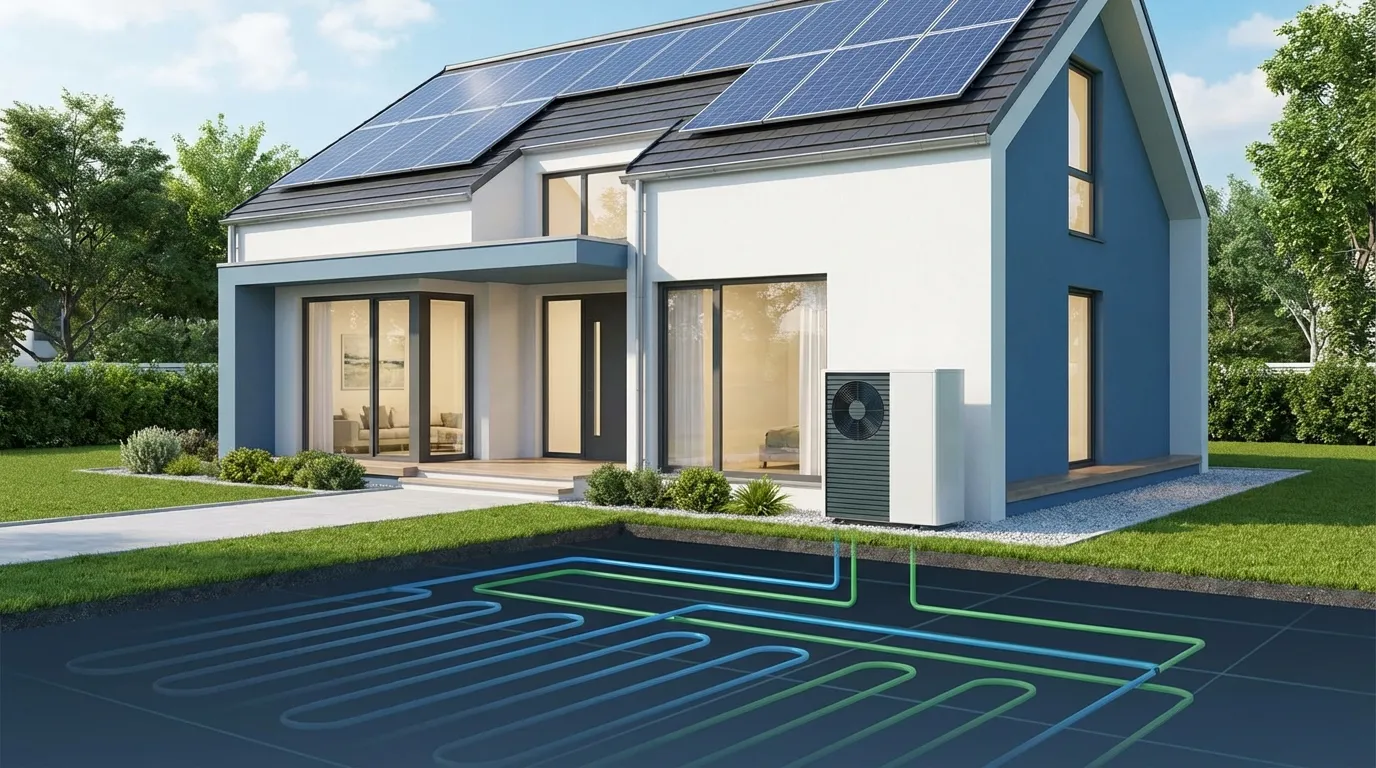
Homeowners installing geothermal heat pumps in 2026 face upfront costs of $15,000 to $38,000—but recover 100% of the investment within 5 to 10 years through energy savings that cut heating and cooling bills by 30% to 60% annually. And the federal government now covers 30% of installation costs through IRA tax credits that run through 2032, slicing the effective price to $10,500 to $26,600 before state and utility rebates stack on top.
But here's the tension: geothermal systems deliver the lowest operating costs of any residential HVAC technology while demanding the highest installation price. So the decision hinges on whether your property has suitable geology, whether you plan to stay in the home long enough to capture the payback, and whether your climate zone justifies the premium over air-source alternatives that cost $8,000 to $18,000 installed.
The math shifts dramatically when you layer federal, state, and utility incentives. California homeowners in 2026 access heat pump rebates worth $3,000 to $6,500 from local utilities, the California Tech Clean program offering $3,000 for low-income households, and the federal IRA credit covering 30% of total project costs with no dollar cap. Calculate your exact savings with our free rebate calculator to see how incentives cut your net cost.
How Much Does a Geothermal Heat Pump Cost in 2026?
Geothermal heat pump installations in 2026 range from $15,000 to $38,000 depending on system size, loop configuration, drilling depth, and property geology. Horizontal closed-loop systems in soft soil with ample land cost $15,000 to $25,000, while vertical closed-loop systems requiring 150 to 500 feet of drilling in bedrock reach $25,000 to $38,000.
The ground loop accounts for 50% to 70% of total project cost. Horizontal loops require 1,500 to 2,500 feet of trenching across 0.5 to 1.5 acres and cost $10 to $20 per linear foot. Vertical loops drill 3 to 5 boreholes 150 to 500 feet deep and cost $20 to $40 per linear foot—but need only 400 to 600 square feet of surface area.
Equipment costs run $6,000 to $12,000 for the heat pump unit rated 3 to 5 tons. ENERGY STAR-certified models with variable-speed compressors and desuperheaters that generate free hot water add $1,500 to $3,000 to equipment costs but cut electricity use by 25% to 40% compared to single-speed units.
Labor for installing the indoor heat pump, connecting refrigerant lines, and integrating with existing ductwork adds $3,000 to $6,000. Properties without ductwork face an additional $5,000 to $15,000 to install a complete distribution system.
"Geothermal heat pumps use 25% to 50% less electricity than conventional heating or cooling systems." — U.S. Department of Energy
What's the ROI and Payback Period for Geothermal Heat Pumps?
Geothermal heat pump payback periods in 2026 average 5 to 10 years, with cold-climate homes replacing electric resistance heat recovering costs in 3 to 5 years while mild-climate homes replacing natural gas furnaces need 12 to 15 years to break even. Annual energy savings of $800 to $2,500 compound over the system's 20 to 25 year lifespan to deliver lifetime net savings of $16,000 to $62,500.
The federal IRA tax credit covering 30% of installation costs shortens payback by 2 to 3 years. A $25,000 geothermal system receives a $7,500 federal credit, reducing net cost to $17,500. And state rebates stack on top—California's Tech Clean California program offers $3,000 for income-qualified households, cutting net cost to $14,500.
Homes in IECC climate zones 5 through 7 (cold climates) see the fastest ROI because geothermal systems maintain 300% to 500% efficiency even at -10°F outdoor temperatures, while air-source heat pumps drop to 150% to 200% efficiency and require backup electric resistance heat. So a Minnesota home replacing electric baseboard heat with geothermal saves $2,400 annually and reaches payback in 4.2 years after federal credits.
Properties with high cooling loads in hot climates also accelerate payback. Arizona homes running air conditioning 6 to 8 months per year save $1,800 to $2,200 annually with geothermal, reaching payback in 6 to 7 years after federal credits.
Resale value increases by 5% to 7% for homes with geothermal systems according to National Association of Realtors data. A $400,000 home gains $20,000 to $28,000 in market value, recovering 80% to 110% of net installation cost before factoring in energy savings.
Is Your Home Suitable? Climate Zone and Geological Requirements
Geothermal heat pumps operate efficiently in all 50 states but deliver the strongest ROI in IECC climate zones 4 through 7 where annual heating degree days exceed 4,000 and ground temperatures stabilize at 45°F to 75°F year-round. Cold climates maximize heating savings while hot climates maximize cooling savings—temperate zones see the slowest payback.
Geological requirements depend on loop configuration. Horizontal closed-loop systems need 0.5 to 1.5 acres of land with soil depth of 4 to 6 feet and require trenching equipment to reach soil. Vertical closed-loop systems need only 400 to 600 square feet but require bedrock suitable for drilling 150 to 500 feet deep without hitting groundwater contamination zones.
Properties with high water tables below 25 feet can't use pond loops. Properties with bedrock shallower than 50 feet can't support horizontal loops. And properties with underground utilities, septic systems, or easements may lack clear space for trenching.
Soil thermal conductivity affects loop sizing. Sandy or gravelly soil with high moisture content transfers heat efficiently and requires 150 to 200 feet of loop per ton of capacity. Dry clay or rocky soil transfers heat slowly and requires 200 to 300 feet of loop per ton—increasing installation costs by 30% to 50%.
A professional site assessment costs $300 to $800 and includes soil analysis, thermal conductivity testing, drilling feasibility, and loop sizing calculations. The assessment determines whether your property suits geothermal and whether horizontal or vertical loops cost less.
Check geothermal tax credit eligibility requirements before starting site assessment—the IRA credit covers assessment costs as part of total project expenses.
Geothermal vs. Air Source Heat Pumps vs. Traditional HVAC: Which Costs Less Long-Term?
Geothermal heat pumps deliver the lowest lifetime costs despite the highest upfront price. Air-source heat pumps offer the best balance of moderate installation cost and strong efficiency. Traditional gas furnaces with central air conditioning cost the least upfront but the most over 20 years in cold climates.
| System Type | Installation Cost | Annual Operating Cost | 20-Year Total Cost | Lifetime Savings |
|---|---|---|---|---|
| Geothermal Heat Pump | $15,000-$38,000 | $600-$1,200 | $27,000-$62,000 | Baseline |
| Air-Source Heat Pump | $8,000-$18,000 | $900-$1,800 | $26,000-$54,000 | $1,000-$8,000 less |
| Gas Furnace + Central AC | $6,000-$12,000 | $1,400-$2,600 | $34,000-$64,000 | $7,000-$2,000 more |
| Electric Resistance Heat | $3,000-$6,000 | $2,800-$4,200 | $59,000-$90,000 | $32,000-$28,000 more |
Geothermal systems maintain 300% to 500% efficiency year-round because ground temperatures stay constant at 45°F to 75°F. Air-source heat pumps reach 250% to 400% efficiency in moderate weather but drop to 150% to 200% efficiency below 20°F and require backup heat. So geothermal cuts heating costs by 40% to 60% compared to air-source in cold climates but only 10% to 20% in mild climates.
Cooling costs favor geothermal in all climates. Geothermal systems maintain 400% to 600% cooling efficiency while air-source units reach 300% to 450% efficiency. And geothermal desuperheaters generate free hot water during cooling season, saving an additional $200 to $400 annually.
Maintenance costs run $150 to $300 annually for geothermal versus $200 to $400 for air-source systems. Geothermal ground loops last 50+ years while indoor components last 20 to 25 years. Air-source outdoor units last 15 to 20 years due to exposure to weather.
Properties with existing natural gas service in mild climates see the slowest geothermal payback because gas furnaces deliver low operating costs of $800 to $1,400 annually. But homes in areas with high gas prices above $2.50 per therm or without gas service favor geothermal over all alternatives.
Explore energy tax credits to see how federal incentives affect the total cost comparison across system types.
Available Tax Credits and Rebates (Including the New IRA Changes)
The federal Residential Clean Energy Credit (Section 25D) ended for expenditures made after December 31, 2025, and the IRS treats an expenditure as made when installation is completed (IRS FS-2025-05). Federal tax credits for this work have ended, but state, local and utility rebates may still apply; check what is available at your address with the DuloCore rebate calculator. The credit includes equipment, labor, ground loop installation, ductwork modifications, electrical upgrades, and site assessment costs. A $25,000 installation receives a $7,500 credit, reducing net cost to $17,500.
The credit applies to principal residences and second homes but not rental properties. Form 5695 only covers qualifying work completed by December 31, 2025 and claimed on a 2025 return; the federal 25C and 25D credits ended after that date (IRS FS-2025-05). And the credit carries forward indefinitely if it exceeds tax liability in the installation year.
California programs for 2026 include:
- Tech Clean California: $3,000 for income-qualified households (≤80% area median income)
- SMUD Rebates: $2,500 for geothermal heat pumps in Sacramento Municipal Utility District territory
- PG&E Energy Savings Assistance Program: Up to $6,500 for low-income households
- SoCalGas Energy Savings Assistance: $3,000 to $5,000 for income-qualified customers
Check current 2026 program availability through DSIRE USA because utility rebates change annually and many operate on first-come first-served budgets that exhaust mid-year.
Local air quality management districts in California offer additional incentives for replacing gas furnaces with electric heat pumps. South Coast AQMD provides $3,000 to $4,000 for heat pump installations that eliminate natural gas combustion.
The federal Residential Clean Energy Credit (Section 25D) ended for expenditures made after December 31, 2025, and the IRS treats an expenditure as made when installation is completed (IRS FS-2025-05).
What Installation Process Should You Expect?
Geothermal heat pump installation takes 3 to 7 days depending on loop configuration and site conditions. Vertical closed-loop systems with drilling require 2 to 3 days for boreholes plus 1 to 2 days for equipment installation. Horizontal closed-loop systems require 1 to 2 days for trenching plus 1 to 2 days for equipment.
The process starts with a site assessment that tests soil thermal conductivity, identifies underground utilities, and calculates heat load requirements. Contractors drill test holes or dig test trenches to verify geological conditions match initial assumptions. The assessment takes 4 to 8 hours and costs $300 to $800.
Loop installation follows site assessment approval. Vertical systems drill 3 to 5 boreholes 150 to 500 feet deep spaced 15 to 20 feet apart, insert U-bend pipe loops, and backfill with thermally-enhanced grout. Horizontal systems excavate trenches 4 to 6 feet deep in parallel or slinky configurations and lay high-density polyethylene pipe.
Ground loop pressure testing verifies leak-free installation before connecting to the indoor heat pump. Contractors flush the loop with water, pressurize to 100 PSI, and monitor for 24 hours to confirm zero pressure loss.
Indoor equipment installation includes mounting the heat pump, connecting refrigerant lines to the ground loop, integrating with existing ductwork or installing new ducts, and wiring electrical connections. Systems require dedicated 240V circuits with 40 to 60 amp service—properties with 100 amp panels may need electrical panel upgrades adding $1,500 to $3,000.
Final commissioning includes charging the refrigerant circuit, programming the thermostat, testing heating and cooling modes, and training the homeowner on system operation. Contractors provide documentation for claiming the federal IRA credit and state rebates.
Permit requirements vary by jurisdiction. Most municipalities require building permits for HVAC equipment installation and electrical work, plus drilling permits for vertical loops. Permit costs run $200 to $800 and add 1 to 3 weeks to project timelines for review and inspection.
Official Sources
- DOE Geothermal Heat Pumps — Federal guidance on system types, efficiency, and incentives
- ENERGY STAR Heat Pumps — Certified equipment database and federal tax credit information (note: the federal 25C and 25D credits ended for projects completed after December 31, 2025)
- DSIRE USA — State-by-state rebate and incentive search tool
Related Reading: Learn more about Heat Pump Energy Audit Evaluation and Home Energy Audit Cost By State.
Related Reading: Learn more about Ira Geothermal Heat Pump Incentives.
Frequently Asked Questions
How much does a geothermal heat pump cost?
Geothermal heat pump installations in 2026 cost $15,000 to $38,000 depending on system size, loop type, and geology. Horizontal closed-loop systems in soft soil with ample land cost $15,000 to $25,000. Vertical closed-loop systems requiring deep drilling in bedrock cost $25,000 to $38,000. The federal IRA tax credit covers 30% of total costs, reducing net price to $10,500 to $26,600 before state and utility rebates.
What rebates are available for geothermal heat pump installation?
California homeowners in 2026 access Tech Clean California rebates worth $3,000 for income-qualified households, utility rebates from SMUD ($2,500), PG&E ($6,500 for low-income), and SoCalGas ($3,000 to $5,000). Local air quality districts offer $3,000 to $4,000 for replacing gas furnaces. The federal Residential Clean Energy Credit (Section 25D) ended for expenditures made after December 31, 2025, and the IRS treats an expenditure as made when installation is completed (IRS FS-2025-05). Check DSIRE USA for current 2026 programs.
Are geothermal heat pumps eligible for federal tax credits in 2026?
The federal Residential Clean Energy Credit (Section 25D) ended for expenditures made after December 31, 2025, and the IRS treats an expenditure as made when installation is completed (IRS FS-2025-05). The credit includes equipment, labor, ground loop installation, ductwork, electrical upgrades, and site assessment. Form 5695 only covers qualifying work completed by December 31, 2025 and claimed on a 2025 return; the federal 25C and 25D credits ended after that date (IRS FS-2025-05). The credit applies to principal residences and second homes but not rental properties.
How long does it take to install a geothermal heat pump?
Geothermal heat pump installation takes 3 to 7 days depending on loop configuration. Vertical closed-loop systems require 2 to 3 days for drilling boreholes plus 1 to 2 days for equipment installation. Horizontal closed-loop systems need 1 to 2 days for trenching plus 1 to 2 days for equipment. Site assessment adds 4 to 8 hours upfront. Permit review adds 1 to 3 weeks before work starts.
What is the payback period for a geothermal heat pump investment?
Geothermal heat pumps reach payback in 5 to 10 years on average, with cold-climate homes replacing electric resistance heat recovering costs in 3 to 5 years. Annual savings of $800 to $2,500 compound over the 20 to 25 year system lifespan to deliver lifetime net savings of $16,000 to $62,500. The federal IRA credit covering 30% of costs shortens payback by 2 to 3 years.
Ready to calculate your exact savings? Use our free rebate calculator to see how federal, state, and utility incentives cut your geothermal heat pump cost. Enter your zip code, system size, and household income to get a personalized estimate of available rebates and your net installation price.
Last reviewed: April 14, 2026. Reviewed by DuloCore Energy Specialists. About the team.
Check your California heat pump rebate eligibility — see the programs you qualify for and the dollar amounts on our California heat pump rebate finder.