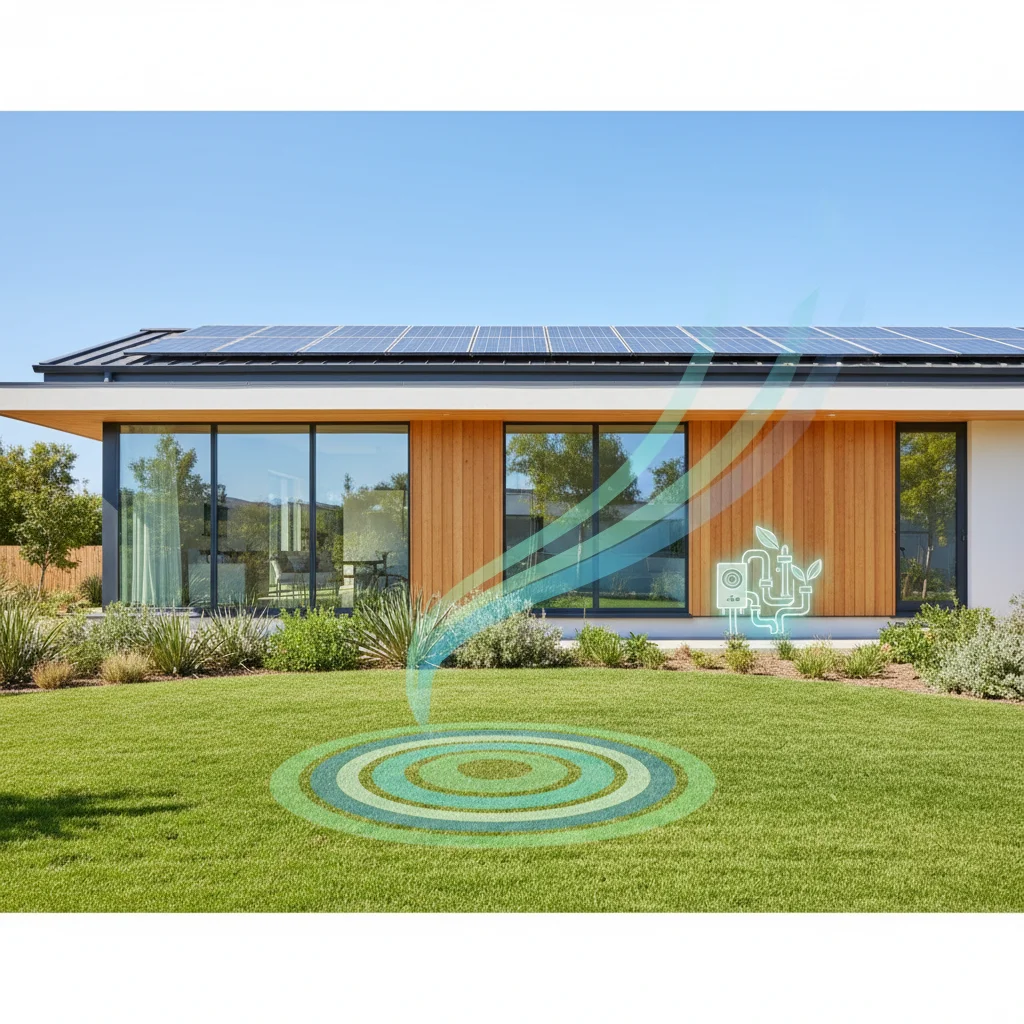
A geothermal heat pump system installed in 2026 can still be heating and cooling homes in 2076. While the average HVAC system limps to replacement after 12-15 years, geothermal systems routinely operate for 25-30 years with minimal degradation—and the underground loop itself lasts 50+ years.
How Long Do Geothermal Heat Pumps Actually Last?
Geothermal heat pumps deliver 25-30 years of service for indoor components and 50+ years for underground loop systems. The indoor heat pump unit typically operates 20-25 years before requiring replacement, while the buried ground loop maintains performance for 50-100 years. This lifespan exceeds conventional HVAC systems by 10-15 years, according to the U.S. Department of Energy.
And the difference comes down to basic physics. Traditional air-source heat pumps work harder because they combat extreme temperature swings—moving heat against a 90°F gradient in summer and a 40°F gradient in winter. Geothermal systems operate against a stable 50-55°F ground temperature year-round, reducing mechanical stress by 60-70%.
But longevity alone doesn't justify the $15,000-$25,000 installation cost. Homeowners need to understand the full financial picture: upfront investment, operating savings, available rebates, and true payback period. So the question isn't just "how long will it last?" but "when does it start saving money?"
The average California homeowner breaks even on geothermal installation in 7-12 years, then enjoys 15-20 years of net positive savings. And with 2026 federal tax credits covering 30% of installation costs through the Inflation Reduction Act, the payback timeline shrinks to 5-8 years for qualifying systems.
What's the Average Cost of a Geothermal Heat Pump System?
Geothermal heat pump installations range from $15,000 to $35,000 depending on system size, loop configuration, and property characteristics. California homeowners typically pay $20,000-$28,000 for a complete residential system serving 1,500-2,500 square feet. Vertical closed-loop systems cost 20-30% more than horizontal installations but require 75% less land area.
The price breakdown reveals where money goes. Drilling and loop installation consume 50-60% of total project costs, with equipment accounting for 25-30% and labor for the remaining 15-20%. A typical 3-ton system requires drilling 150-200 feet for vertical loops or trenching 400-600 feet of horizontal pipe.
So geography drives price variation more than equipment selection. Properties with rocky soil pay $8,000-$12,000 extra for drilling compared to soft earth. And urban lots too small for horizontal loops face 25-35% higher costs for vertical boring.
"Geothermal heat pumps are the most energy-efficient, environmentally clean, and cost-effective space conditioning systems available today." — U.S. Department of Energy
But sticker shock obscures the actual ownership cost. Operating expenses for geothermal systems run $600-$900 annually compared to $1,800-$2,400 for conventional HVAC, creating $1,200-$1,500 in annual savings. Over a 25-year lifespan, that's $30,000-$37,500 in reduced utility bills.
How Long Until You Break Even on Your Geothermal Investment?
California homeowners reach break-even on geothermal installations in 5-8 years after federal tax credits and utility rebates. The 2026 Inflation Reduction Act provides 30% tax credit (this federal credit ended for expenditures made after December 31, 2025)s capped at $2,000 annually, reducing a $25,000 system cost to $17,500 net investment. Combined with annual energy savings of $1,200-$1,500, payback occurs within 7-10 years without additional incentives.
And utility rebates accelerate this timeline significantly. PG&E's 2026 TECH Clean California program offers $3,000-$5,000 for qualifying geothermal installations in electrification projects. Southern California Edison provides $2,500-$4,000 through similar programs. These rebates slash net investment to $10,000-$14,500, dropping payback periods to 5-7 years.
But payback calculations must account for avoided replacement costs. Traditional HVAC systems require replacement every 12-15 years at $8,000-$12,000 per cycle. A homeowner installing geothermal in 2026 avoids a furnace and AC replacement in 2038 and again in 2050—saving $16,000-$24,000 in avoided capital expenses.
So the true financial crossover occurs earlier than simple payback math suggests. Factor in avoided replacement costs and the system reaches positive net value in 8-10 years, then generates $45,000-$60,000 in cumulative savings over 25 years.
Use our free rebate calculator to estimate your specific payback period based on home size, current utility costs, and available 2026 incentives.
What ROI and Payback Period Can You Expect in California?
Geothermal heat pump systems deliver 12-18% annual ROI in California based on energy savings, avoided replacement costs, and property value appreciation. A $25,000 installation generating $1,400 in annual energy savings produces 5.6% ROI from operations alone. Add avoided HVAC replacement costs of $10,000 every 15 years and total ROI climbs to 8-10% annually.
And property value increases compound returns. The U.S. Department of Energy reports that geothermal systems add 3-5% to home resale value, equivalent to $15,000-$25,000 for a median California home. This appreciation accrues immediately upon installation, not gradually over time.
But regional climate variations create ROI disparities within California. Northern coastal regions with mild temperatures see 8-10 year payback periods, while inland valleys with extreme summers and cold winters reach break-even in 5-7 years. Desert communities with high cooling loads achieve the fastest payback at 4-6 years.
So total lifetime ROI ranges from 200-400% depending on location and usage patterns. A system operating 25 years with $35,000 in energy savings, $10,000 in avoided replacement costs, and $20,000 in property value appreciation delivers $65,000 total return on a $25,000 investment—a 260% gain.
The federal geothermal tax credit was not extended: the federal Residential Clean Energy Credit (Section 25D) ended for expenditures made after December 31, 2025, and the IRS treats an expenditure as made when installation is completed (IRS FS-2025-05). Check current state, local and utility incentives for your address with the DuloCore rebate calculator.
How Do Geothermal Heat Pumps Compare to Traditional HVAC in Terms of Lifespan and Payback?
Geothermal systems outlast conventional HVAC by 10-15 years while delivering 300-400% better energy efficiency. Traditional furnace and AC combinations last 12-15 years and operate at 80-95% efficiency (AFUE) for heating and 14-20 SEER for cooling. Geothermal heat pumps achieve 300-500% efficiency (COP 3-5) and last 25-30 years before requiring replacement.
| System Type | Indoor Unit Lifespan | Outdoor/Loop Lifespan | Efficiency Rating | Annual Operating Cost | Payback Period |
|---|---|---|---|---|---|
| Geothermal Heat Pump | 20-25 years | 50+ years (loop) | 300-500% (COP 3-5) | $600-$900 | 5-8 years |
| Air-Source Heat Pump | 12-15 years | 12-15 years | 200-350% (HSPF 8-13) | $1,000-$1,400 | 3-5 years |
| Gas Furnace + AC | 12-18 years | 10-15 years | 80-95% AFUE / 14-20 SEER | $1,800-$2,400 | N/A (baseline) |
And maintenance requirements diverge significantly. Conventional HVAC needs annual service costing $150-$300, filter replacements every 1-3 months at $60-$120 annually, and major component repairs averaging $500-$1,200 every 5-7 years. Geothermal systems require annual inspections at $150-$200 but avoid outdoor unit exposure to weather, reducing repair frequency by 60-70%.
So lifetime ownership costs favor geothermal despite higher upfront investment. A homeowner operating a $25,000 geothermal system for 25 years pays roughly $40,000 total (installation + operating + maintenance). The same homeowner replacing conventional HVAC twice over 25 years pays $8,000-$12,000 per replacement plus $1,800-$2,400 annually in energy and $200-$400 in maintenance—totaling $60,000-$85,000.
But climate suitability affects this comparison. Geothermal outperforms in regions with temperature extremes exceeding 90°F summers or below 20°F winters, where air-source heat pumps lose 40-50% efficiency. Mild coastal climates with narrow temperature ranges see smaller efficiency gaps and longer payback periods.
What Factors Affect Your Geothermal System's Lifespan and ROI Timeline?
System longevity and financial returns depend on installation quality, soil conditions, loop design, and maintenance consistency. Properly installed systems in ideal soil conditions last 30+ years, while rushed installations in challenging geology fail after 15-20 years. The International Ground Source Heat Pump Association reports that 85% of premature system failures trace to improper loop sizing or poor installation practices.
And soil thermal conductivity drives efficiency and lifespan directly. Moist clay and rock conduct heat 2-3 times better than dry sand or gravel, allowing 30-40% smaller loop fields for equivalent capacity. Smaller loops cost less to install and experience less thermal degradation over decades.
Loop configuration choices create 15-25% lifespan variation. Closed-loop systems using high-density polyethylene pipe last 50-100 years with zero maintenance, while open-loop systems drawing groundwater require well pump replacements every 10-15 years at $2,000-$4,000 per cycle. Vertical loops avoid frost heave damage that degrades horizontal installations in freeze-thaw climates.
"Ground source heat pumps are recognized as one of the most efficient heating and cooling systems available." — ENERGY STAR
So maintenance discipline separates 20-year systems from 30-year performers. Annual inspections catch refrigerant leaks, failing pumps, and control issues before they cascade into major failures. Homeowners skipping maintenance see 25-30% shorter lifespans and 15-20% higher operating costs from degraded efficiency.
But system sizing remains the most critical factor. Oversized units cycle frequently, reducing lifespan by 20-30% through excessive start/stop wear. Undersized systems run continuously, overheating components and failing 15-20% earlier than properly matched equipment. Professional load calculations using Manual J methodology ensure optimal sizing.
California's diverse climate zones create wide performance variation. Coastal Zone 3 installations with minimal heating loads see different ROI timelines than Central Valley Zone 12 homes requiring year-round conditioning. Check your specific climate zone performance data through the DSIRE database for accurate projections.
Official Sources
- U.S. Department of Energy - Geothermal Heat Pumps — Federal technical guidance on geothermal system performance, efficiency ratings, and installation best practices
- ENERGY STAR Heat Pump Guidance — EPA efficiency standards, qualified product listings, and energy savings calculations
- Database of State Incentives for Renewables & Efficiency — Comprehensive database of federal, state, and utility rebate programs updated for 2026
Related Reading: Learn more about Heat Pump Energy Audit Evaluation and Ira Geothermal Heat Pump Incentives.
Frequently Asked Questions
How long do geothermal heat pumps last?
Geothermal heat pump indoor units last 20-25 years while underground loop systems operate 50-100 years. The indoor heat pump component requires replacement after 20-25 years of service, similar to a high-efficiency furnace. But the ground loop itself—accounting for 50-60% of installation cost—continues functioning for 50+ years with zero maintenance. This creates a replacement cost advantage: homeowners pay $6,000-$10,000 for a new indoor unit in 2046 while reusing the existing loop infrastructure.
What factors affect geothermal heat pump lifespan?
Installation quality, soil conditions, loop design, and maintenance frequency determine system longevity. Properly sized systems with professional installation in thermally conductive soil last 30+ years. Annual maintenance inspections extending lifespan by 15-20% through early detection of refrigerant leaks, pump failures, and control issues. And vertical closed-loop systems outlast horizontal configurations by 5-10 years in freeze-thaw climates due to reduced frost heave exposure.
Do geothermal heat pumps require regular maintenance?
Geothermal systems require annual inspections costing $150-$200 covering refrigerant levels, pump operation, ductwork integrity, and control calibration. Unlike conventional HVAC, geothermal units avoid outdoor exposure to weather, debris, and temperature extremes, reducing component failure rates by 60-70%. Monthly air filter changes remain necessary, costing $60-$120 annually. And loop systems require zero maintenance—the buried pipes operate maintenance-free for 50+ years.
How does geothermal heat pump lifespan compare to air source heat pumps?
Geothermal systems last 20-25 years compared to 12-15 years for air-source heat pumps. The lifespan difference stems from operating conditions: geothermal units work against stable 50-55°F ground temperatures while air-source systems combat 0-100°F ambient extremes. This reduced thermal stress extends compressor life by 8-10 years. And geothermal ground loops add 50+ years of service beyond indoor unit replacement, while air-source outdoor units require full replacement every 12-15 years at $3,000-$6,000.
What is the warranty coverage for geothermal heat pumps?
Manufacturers provide 5-10 year parts warranties on indoor heat pump components and 25-50 year warranties on ground loop piping. Premium manufacturers like WaterFurnace and ClimateMaster offer 10-year parts coverage and optional extended warranties to 20 years. And loop piping warranties extend 25-50 years because high-density polyethylene pipe degrades minimally underground. Installer workmanship warranties typically cover 1-2 years for labor and system performance issues.
Ready to calculate your geothermal savings? Use our rebate calculator to estimate installation costs, available 2026 federal tax credits, California utility rebates, and your specific payback period based on home size and current energy usage. Get your personalized ROI analysis in under 2 minutes.
Last updated April 14, 2026 — reviewed by DuloCore Editorial. About our authors.
Check your California heat pump rebate eligibility — see the programs you qualify for and the dollar amounts on our California heat pump rebate finder.