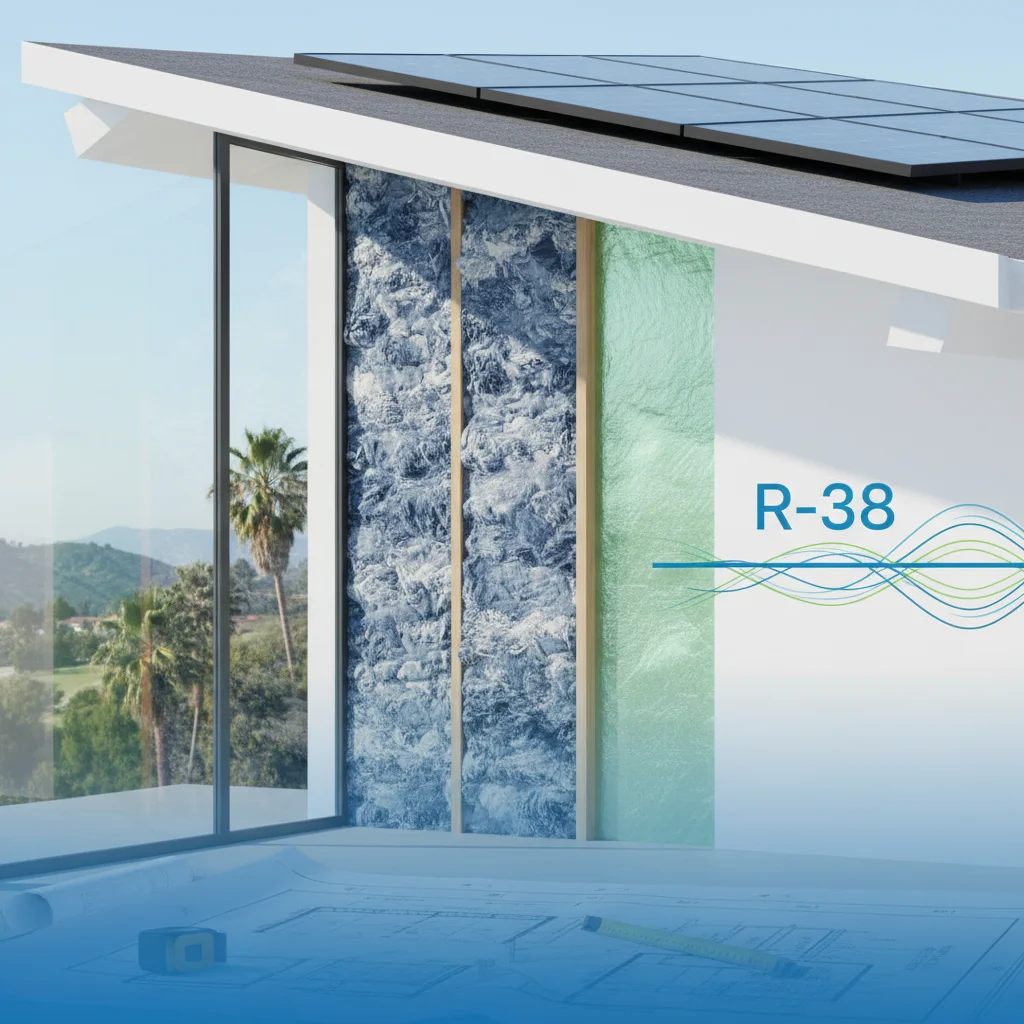
California homeowners waste $8.2 billion annually on heating and cooling costs because of inadequate attic insulation. And the California Energy Commission now mandates R-38 minimum insulation levels for attic spaces in most climate zones — a 27% increase from the previous R-30 standard that took effect in the 2022 Title 24 building code update.
What Are California's R-38 Insulation Requirements for Your Home?
California's Title 24 building code requires R-38 minimum insulation in attic spaces for homes in climate zones 1-15. R-38 refers to thermal resistance — the material's ability to resist heat flow measured in units of thermal resistance per inch. The requirement applies to new construction and attic replacements, though existing homes aren't required to retrofit unless undergoing major renovations affecting more than 50% of the roof structure.
Climate zones 16 (mountains) require R-49 for enhanced cold weather protection. But coastal zones 6-7 maintain R-30 minimums due to moderate temperatures. The California Energy Commission estimates R-38 insulation reduces annual cooling costs by $320-$480 compared to R-30 in Sacramento and Fresno regions.
Which R-38 Insulation Products Qualify for California Rebates in 2026?
ENERGY STAR certified blown-in fiberglass, cellulose, and mineral wool products qualify for California utility rebate programs in 2026. PG&E offers $0.15-$0.20 per square foot for R-38 attic upgrades, covering 400-600 square foot installations with $60-$120 rebates. SoCal Gas provides tiered incentives: $200 for homes under 1,500 square feet, $300 for 1,500-2,500 square feet, and $400 for homes exceeding 2,500 square feet.
The federal Energy Efficient Home Improvement Credit (Section 25C) ended for property placed in service after December 31, 2025 (IRS FS-2025-05). Federal tax credits for this work have ended, but state, local and utility rebates may still apply; check what is available at your address with the DuloCore rebate calculator. Batt insulation qualifies if it achieves R-38 cumulative value through multiple layers. Use our free rebate calculator to estimate your total savings from state and federal programs.
"Properly installed attic insulation can reduce heating and cooling costs by 10-50% depending on existing insulation levels." — U.S. Department of Energy
How Much Can You Save with R-38 Insulation? ROI and Payback Period Calculator
R-38 insulation installation costs $1.50-$3.50 per square foot including materials and labor. A typical 1,800 square foot attic requires $2,700-$6,300 for complete R-38 coverage. So annual energy savings range from $420-$680 in California's Central Valley climate zones, creating a 4-9 year payback period before incentives.
After applying the 30% federal tax credit ($810-$1,890) and utility rebates ($200-$400), net installation costs drop to $1,610-$4,010. This accelerates payback to 2.4-6 years. Homes upgrading from R-11 or no insulation see the fastest returns — Sacramento homeowners report $740 annual savings with 2.2-year payback periods.
But coastal regions with milder climates extend payback to 8-12 years due to lower baseline energy consumption. Calculate your specific savings potential with our rebate calculator using your utility rates and climate zone.
R-38 vs. R-30, R-49: Which Insulation Level Is Right for Your Climate Zone?
R-38 provides 27% greater thermal resistance than R-30, translating to $80-$140 additional annual savings in heating-dominant climates like Sacramento (zone 12) and Redding (zone 13). R-30 remains sufficient for coastal zones 6-7 where temperature swings rarely exceed 30°F. And R-49 becomes cost-effective in mountain regions (zone 16) where winter temperatures drop below 20°F for extended periods.
The California Energy Commission's cost-effectiveness analysis shows R-38 optimizes the price-to-performance ratio for 82% of California households. R-49 adds $0.80-$1.20 per square foot ($1,440-$2,160 for 1,800 square feet) but only generates $60-$100 additional annual savings in most California climate zones, extending payback by 14-18 years.
So most Central Valley and inland homeowners maximize ROI with R-38. Check the California Title 24 climate zone map to determine your specific requirement.
How Long Does R-38 Insulation Last and When Should You Replace It?
Blown-in fiberglass and cellulose insulation maintains R-38 thermal performance for 20-25 years under normal conditions. But moisture exposure from roof leaks reduces effectiveness by 40-60% and requires immediate replacement to prevent mold growth. Fiberglass batts last 80-100 years if properly installed without compression or gaps.
Annual attic inspections detect three failure indicators: visible settling (reduction in loft height by 2+ inches), moisture stains, or rodent contamination. And compressed insulation loses 30-50% of its R-value permanently. Homes built before 2000 with original insulation typically measure R-11 to R-19 — upgrading to R-38 provides the largest energy savings opportunity.
The Department of Energy recommends replacement when existing insulation drops below R-19 or shows visible damage. Learn more about related energy tax credits for other home improvements.
What's the Installation Process and Timeline for R-38 Insulation Upgrades?
Professional R-38 insulation installation takes 4-8 hours for a standard 1,800 square foot attic. Contractors first remove debris and seal air leaks around electrical fixtures, pipes, and ductwork. Then blown-in insulation fills the attic space to achieve 10-14 inch depth for fiberglass or 11-13 inches for cellulose, measured with depth markers.
Air sealing before insulation installation increases efficiency by 15-20% according to Lawrence Berkeley National Laboratory. The process includes caulking top plates, sealing recessed lighting fixtures with ICAT-rated enclosures, and weatherstripping attic access hatches. DIY installation saves $0.80-$1.50 per square foot but requires rented blowing equipment ($75-$150 daily) and protective gear.
But improper installation voids utility rebates and reduces effectiveness by 25-40%. California contractors must hold C-2 (Insulation and Acoustical) specialty licenses. So verify credentials through the Contractors State License Board before hiring. Explore heat pump rebates for coordinated energy efficiency upgrades.
Official Sources
- U.S. Department of Energy - Insulation — Federal energy efficiency standards and installation guidelines
- California Energy Commission - Title 24 — California building energy efficiency standards and climate zone requirements
- ENERGY STAR - Insulation Installation — Proper installation techniques and performance specifications
Related Reading: Learn more about Insulation Energy Audit Requirements and Insulation R Value Chart.
Frequently Asked Questions
What is R-38 insulation and why is it required in California?
R-38 insulation provides 38 units of thermal resistance per inch, representing the material's ability to slow heat transfer. California's Title 24 building code mandates R-38 minimum levels in attic spaces for climate zones 1-15 to reduce energy consumption and meet 2022 efficiency standards. The requirement supports California's goal to reduce residential energy use by 30% by 2030 compared to 2020 baseline levels.
How much does R-38 insulation installation cost in California?
R-38 insulation installation costs $1.50-$3.50 per square foot including materials and labor. A typical 1,800 square foot attic requires $2,700-$6,300 for complete coverage. After applying the 30% federal tax credit ($810-$1,890) and utility rebates ($200-$400), net costs drop to $1,610-$4,010. Blown-in fiberglass costs less than cellulose or mineral wool options.
Am I eligible for rebates if I upgrade to R-38 insulation?
California homeowners qualify for utility rebates from PG&E, SoCal Gas, and SMUD ranging from $60-$400 depending on home size and existing insulation levels. The federal Energy Efficient Home Improvement Credit (Section 25C) ended for property placed in service after December 31, 2025 (IRS FS-2025-05). ENERGY STAR certified products installed by licensed contractors are required for both incentive types.
What is the difference between R-38 and R-30 insulation for California homes?
R-38 provides 27% greater thermal resistance than R-30, requiring 2-3 additional inches of material depth. R-38 reduces annual cooling costs by $80-$140 compared to R-30 in inland California climate zones. But coastal regions see minimal savings differences due to moderate temperatures. R-38 requires 10-14 inches of blown-in fiberglass compared to 8-10 inches for R-30.
What is the deadline for R-38 insulation rebate applications in California?
Most California utility rebate programs accept applications year-round with 60-90 day submission windows after installation completion. PG&E and SoCal Gas require pre-approval applications before starting work. And 2026 program budgets typically deplete by October-November, so early applications maximize approval chances.
Ready to maximize your insulation rebates? Use DuloCore's rebate calculator to discover your exact savings from R-38 insulation upgrades. Get instant estimates combining federal tax credits and California utility incentives — calculated for your specific climate zone and home size.
Last reviewed: April 14, 2026. Reviewed by DuloCore Energy Specialists. About the team.
Check your California insulation rebate eligibility — see the programs you qualify for and the dollar amounts on our California insulation rebate finder.