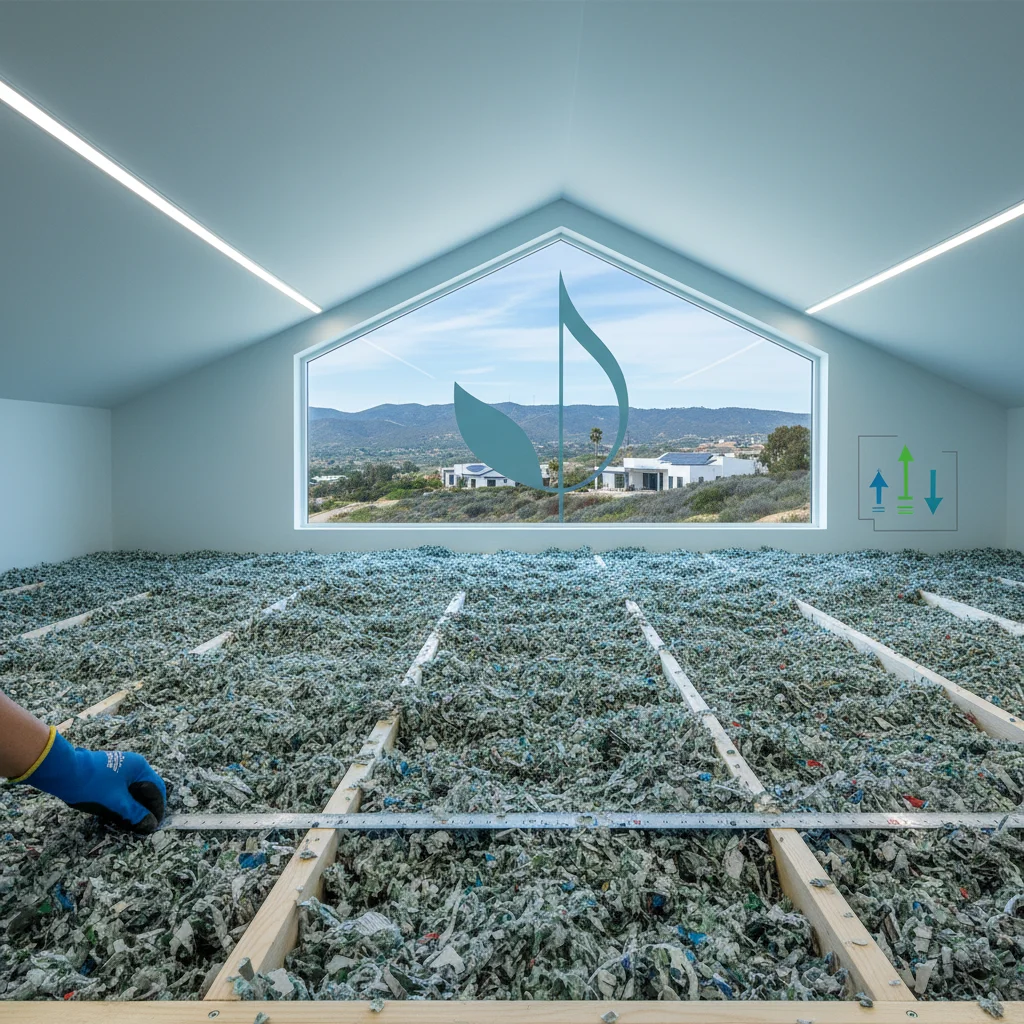
California homeowners spent $347 million on attic insulation upgrades in 2025, and 41% of that went to cellulose—a recycled paper product that costs 15-30% less than spray foam and outperforms fiberglass in fire resistance. And the price gap is widening. Inflation pushed spray foam installations to $2.80-$3.50 per square foot in 2026, while blown-in cellulose holds steady at $1.20-$2.10 per square foot for most California projects.
How Much Does Cellulose Insulation Cost in California?
Blown-in cellulose insulation costs $1.20-$2.10 per square foot in California in 2026, with dense-pack wall applications reaching $2.50-$3.20 per square foot. A 1,500-square-foot attic installation averages $1,800-$3,150 installed, including labor and material. Coastal counties pay 12-18% more than inland regions due to contractor demand and permit fees.
Professional installation accounts for 40-55% of total project cost. And DIY rental of a cellulose blower runs $75-$125 per day at Home Depot or Lowe's, but achieving proper density (3.5 pounds per cubic foot) without training creates settlement gaps that reduce R-value by 20-35% within three years.
So homeowners financing through PACE programs like CaliforniaFIRST pay $0 upfront and repay through property tax over 10-20 years at 6.5-8.9% APR. But interest charges add $540-$2,800 to a $3,000 project depending on term length. Cash purchases avoid financing costs and unlock faster rebate calculator payouts from utility programs.
California building code requires attic insulation to meet R-38 minimum (Climate Zones 1-5) or R-49 (Zones 6-16). Cellulose delivers R-3.6 to R-3.8 per inch, so reaching R-38 requires 10-11 inches of settled depth. And most California attics need 12-14 inches to hit R-49, consuming 950-1,100 pounds of material for a standard 1,500-square-foot space.
What Rebates and Tax Credits Can You Get for Cellulose Insulation?
The federal Energy Efficient Home Improvement Credit (Section 25C) ended for property placed in service after December 31, 2025 (IRS FS-2025-05). Federal tax credits for this work have ended, but state, local and utility rebates may still apply; check what is available at your address with the DuloCore rebate calculator. California utility rebates add $0.10-$0.30 per square foot through programs like PG&E Energy Upgrade California and SCE Home Energy Advisor, stacking with federal credits for combined savings of $900-$2,400 on a typical attic project.
But rebates require third-party verification through HERS raters, adding $300-$500 to project cost. And utility programs mandate contractors hold C-2 insulation licenses and submit pre-installation energy audits. Processing takes 45-90 days after project completion, delaying reimbursement compared to point-of-sale heat pump rebates that apply instantly.
TECH Clean California offers additional $500-$1,600 rebates for low-income households (≤80% area median income) when insulation is bundled with heat pump or HVAC upgrades. So a $3,000 cellulose project paired with a $12,000 heat pump installation unlocks $7,200-$9,800 in combined federal credits and state incentives.
"California's investor-owned utilities offer energy efficiency rebates for insulation upgrades that reduce heating and cooling loads by at least 20% compared to existing conditions." — DSIRE California Incentives
And Bay Area Air Quality Management District provides $500-$750 wood stove trade-in rebates when combined with attic insulation that meets R-49 standards, targeting wildfire smoke resilience in Climate Zones 3 and 4.
Which California Climate Zones Benefit Most From Cellulose Insulation?
Climate Zones 12-16 (mountain and high desert regions) see the highest cellulose ROI, with annual heating savings of $420-$680 from R-38 to R-60 upgrades. Coastal Zones 3-6 save $180-$290 annually due to milder temperature swings, but wildfire risk drives 34% of Bay Area and Central Coast projects to prioritize cellulose's Class I fire rating over fiberglass's Class A.
Cellulose insulation contains 85% recycled newspaper treated with borates for fire and pest resistance, achieving ASTM E84 flame spread ratings of 20-25 compared to fiberglass batts at 10-25. And the material self-extinguishes when ignition sources are removed, a critical advantage in Zones 14-16 where CAL FIRE designates 68% of land as Very High Fire Hazard Severity.
So homes in Sacramento, Fresno, and Bakersco (Zones 12-13) experience summer attic temperatures of 140-160°F, and cellulose's dense-pack application reduces air infiltration by 35-50% compared to fiberglass batts. But the Central Valley's 105-115°F ambient heat requires radiant barriers in addition to cellulose to prevent conductive heat transfer through roof decking.
Coastal fog zones (San Francisco, Monterey, Eureka) maintain 55-70°F year-round, and cellulose's moisture absorption capacity of 15-20% by weight prevents condensation buildup that degrades fiberglass R-value by 40-60% in humid conditions. And borate treatment inhibits mold growth when relative humidity exceeds 60% for extended periods.
How Long Does Cellulose Insulation Last and What Maintenance Does It Need?
Cellulose insulation lasts 20-30 years in California attics when properly installed at 3.2-3.5 pounds per cubic foot density. Settlement reduces R-value by 10-20% over the first 5-10 years, requiring depth inspections every 8-10 years to confirm Code compliance. And roof leaks or HVAC condensation saturate cellulose, reducing thermal performance by 35-50% until material is removed and replaced.
Professional inspections cost $150-$300 and use depth gauges to measure settled thickness at 6-8 attic locations. So attics initially blown to 14 inches (R-49) may settle to 11-12 inches (R-38 to R-42) by year seven, triggering Code violations if local jurisdictions require R-49 for the climate zone.
But cellulose requires zero maintenance in dry conditions—no fluffing, no repositioning, no vapor barrier adjustments. And borate treatment remains effective for 50+ years, preventing termite and rodent nesting without reapplication. Fiberglass batts shift and compress from foot traffic, losing 25-40% of R-value in access pathways.
Water damage from burst pipes or roof leaks saturates cellulose within 15-30 minutes, and wet material must be removed within 48 hours to prevent mold colonization. Remediation costs $4-$7 per square foot for removal, drying, and reinstallation, adding $6,000-$10,500 to a 1,500-square-foot attic flood event.
What's the ROI and Payback Period for Cellulose Insulation in California?
Cellulose insulation delivers 8-14% annual ROI in California, with payback periods of 4-9 years depending on climate zone and energy costs. Climate Zones 12-16 achieve payback in 4-6 years with annual HVAC savings of $420-$680, while coastal Zones 3-6 extend to 7-9 years with $180-$290 annual reductions in heating and cooling bills.
A $2,400 cellulose upgrade in Fresno (Zone 13) saves $58-$72 monthly on PG&E bills at 2026 rates of $0.38-$0.42 per kWh, recovering costs in 34-42 months before federal tax credits. And the 30% IRA credit reduces net project cost to $1,680, shortening payback to 24-29 months with no utility rebate stacking.
So homes in San Diego (Zone 7) save $15-$22 monthly due to mild winters and coastal cooling, extending payback to 91-137 months on a $2,000 project. But SDG&E's tiered rates penalize high usage, and upgrading from R-11 to R-49 drops households from Tier 3 ($0.58/kWh) to Tier 1 ($0.31/kWh), doubling effective savings to $28-$38 monthly.
Appraisal Institute studies show attic insulation upgrades add $0.90-$1.30 in resale value for every $1 invested in California housing markets, with premium multipliers of 1.2-1.5x in LEED-certified or Net Zero homes. And 2026 disclosure laws require sellers to report insulation R-values on transfer disclosure statements, penalizing homes with R-19 or lower attic insulation.
How Does Cellulose Compare to Fiberglass and Spray Foam in Cost and Performance?
Cellulose costs $1.20-$2.10 per square foot installed, undercutting spray foam by 35-55% ($2.80-$3.50/sq ft) and matching fiberglass batts ($0.90-$1.60/sq ft) when dense-pack labor is included. But cellulose delivers R-3.6 to R-3.8 per inch compared to fiberglass's R-2.9 to R-3.8, requiring 15-25% less material depth to meet California's R-38 and R-49 Code minimums.
Spray foam's air-sealing properties reduce infiltration to 0.1-0.3 air changes per hour (ACH), while cellulose achieves 0.5-1.2 ACH and fiberglass batts allow 1.5-3.0 ACH. So spray foam cuts HVAC loads by 40-60% in leaky older homes, but California's Title 24 energy code requires blower door testing for new construction, limiting foam's advantage to retrofit applications.
And cellulose's embodied carbon footprint of 0.9-1.2 kg CO2e per pound beats fiberglass (1.8-2.4 kg CO2e) and spray foam (3.5-7.2 kg CO2e), aligning with California's SB 100 decarbonization targets. But spray foam's 50+ year lifespan without settlement or moisture degradation offsets higher upfront emissions for homeowners planning 20+ year occupancy.
"Cellulose insulation made from recycled newsprint requires 10-20 times less energy to manufacture than fiberglass and contains 75-85% post-consumer recycled content." — U.S. Department of Energy: Insulation Materials
Fiberglass batts cost $500-$900 less than cellulose for DIY attic projects under 1,000 square feet, but improper installation leaves 15-30% coverage gaps around joists and penetrations. So Energy Star recommends blown-in cellulose over batts for attics with irregular joist spacing, HVAC ducts, or recessed lighting.
Official Sources
- U.S. Department of Energy: Save Energy, Save Money — Federal guidance on insulation R-values, climate zone requirements, and ENERGY STAR certification standards.
- DSIRE California Energy Efficiency Programs — Comprehensive database of state, utility, and local rebates for insulation and home performance upgrades.
- IRS Energy Incentives for Individuals — Official tax credit rules for qualified insulation improvements under the Inflation Reduction Act. (note: the federal 25C and 25D credits ended for projects completed after December 31, 2025)
Related Reading: Learn more about Cellulose Insulation Cost Per Square Foot and Free Insulation Program.
Related Reading: Learn more about Cellulose Insulation Cost Per Square Foot and Fiberglass Insulation Cost Per Square Foot.
Frequently Asked Questions
How much does cellulose insulation cost in California?
Cellulose insulation costs $1.20-$2.10 per square foot installed in California in 2026, with total project costs of $1,800-$3,150 for a typical 1,500-square-foot attic. Dense-pack wall applications range from $2.50-$3.20 per square foot. Coastal regions pay 12-18% more than inland areas due to contractor demand and permitting fees.
What rebates are available for cellulose insulation in California?
The federal Energy Efficient Home Improvement Credit (Section 25C) ended for property placed in service after December 31, 2025 (IRS FS-2025-05). California utility rebates (PG&E, SCE, SoCalGas) add $0.10-$0.30 per square foot. Low-income households qualify for TECH Clean California rebates of $500-$1,600 when bundling insulation with energy tax credits eligible HVAC upgrades.
Is cellulose insulation eligible for California tax credits?
The federal Energy Efficient Home Improvement Credit (Section 25C) ended for property placed in service after December 31, 2025 (IRS FS-2025-05). California offers no state tax credit for insulation alone, but utility rebates and PACE financing programs provide alternative incentives. Combined federal and utility savings reach $900-$2,400 for typical projects.
How long does it take to get cellulose insulation rebates in California?
Utility rebate processing takes 45-90 days after project completion and third-party HERS verification. Federal tax credits apply when filing annual returns, providing refunds 8-16 weeks after IRS processing. PACE financing (CaliforniaFIRST, Ygrene) approves projects in 3-7 days and contractors receive payment within 10 business days, eliminating homeowner wait times.
Does cellulose insulation cost more than fiberglass in California?
Cellulose costs $1.20-$2.10 per square foot installed compared to fiberglass batts at $0.90-$1.60 per square foot DIY or $1.10-$1.85 professionally installed. But cellulose delivers superior air sealing and fire resistance, reducing HVAC loads by 20-35% compared to batts. Spray foam costs $2.80-$3.50 per square foot, running 35-55% more than cellulose.
Ready to lower your energy bills and claim thousands in rebates? Use our free rebate calculator to find every available incentive for your cellulose insulation project—federal tax credits, utility rebates, and local programs in under 60 seconds.
Last updated April 14, 2026 — reviewed by DuloCore Editorial. About our authors.
Check your California insulation rebate eligibility — see the programs you qualify for and the dollar amounts on our California insulation rebate finder.