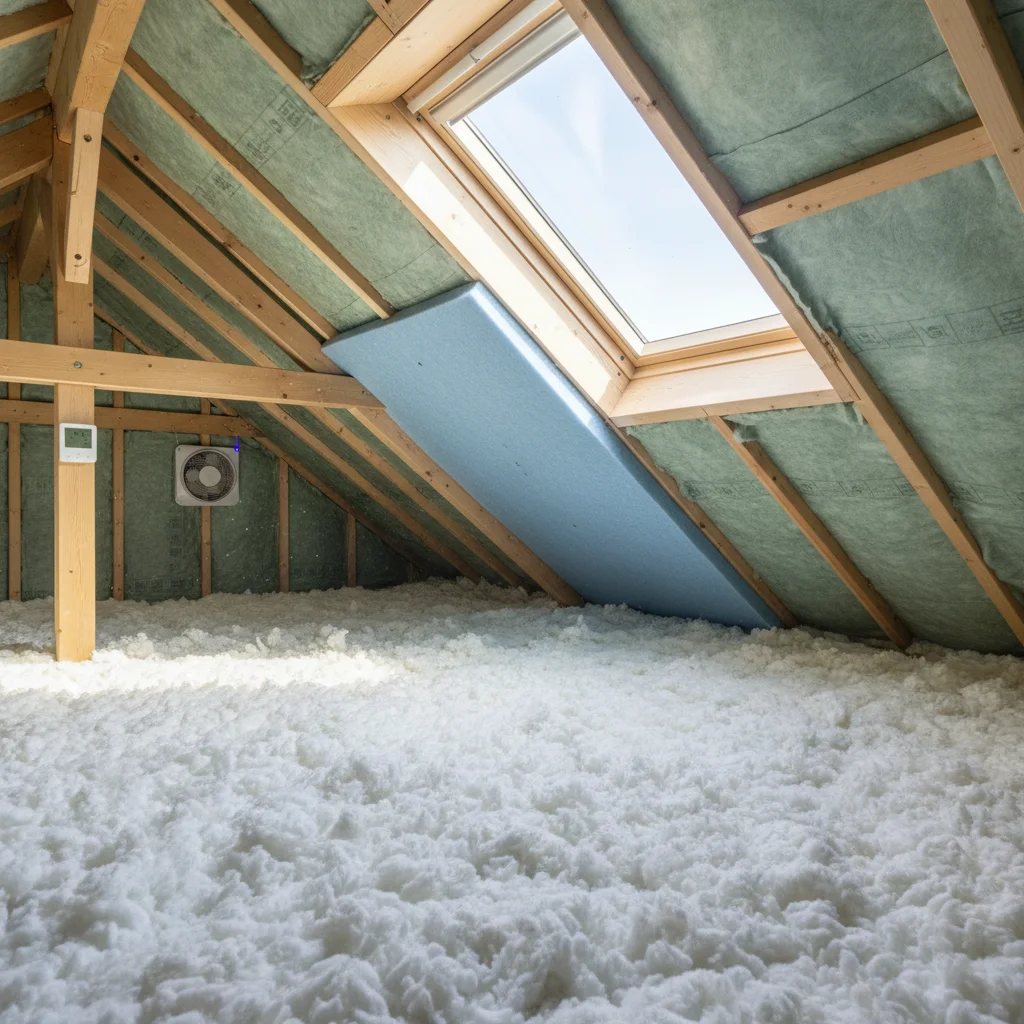
A two-car garage loses an average of $300 per year in heating and cooling energy through uninsulated walls and ceilings. And that's just the direct utility cost—adjacent rooms lose another 15-20% of their conditioned air through shared walls with uninsulated garage spaces.
How Much Does Garage Insulation Cost on Average?
Garage insulation costs range from $1,400 to $4,200 for a standard two-car garage in 2026, with material choices and R-value requirements driving the price spread. Fiberglass batt insulation averages $0.50-$1.20 per square foot installed, while spray foam insulation runs $1.50-$3.50 per square foot. California's Title 24 energy code requires minimum R-13 wall insulation and R-30 ceiling insulation for conditioned spaces, which affects qualifying product selection and total project cost.
So homeowners face a choice: spend $1,400 for basic fiberglass installation that meets code minimums, or invest $4,200 in closed-cell spray foam that delivers R-21 walls and R-38 ceilings. The federal Energy Efficient Home Improvement Credit (Section 25C) ended for property placed in service after December 31, 2025 (IRS FS-2025-05), so that spray foam investment stays at $4,200. Check the rebate calculator to see your specific savings based on garage size and insulation type.
Which Garage Insulation Types Qualify for Rebates?
The federal Energy Efficient Home Improvement Credit (Section 25C) ended for property placed in service after December 31, 2025 (IRS FS-2025-05). Federal tax credits for this work have ended, but state, local and utility rebates may still apply; check what is available at your address with the DuloCore rebate calculator. Wall insulation requires minimum R-13 in California's Zone 3 climate, while ceiling insulation requires R-30 to R-38 depending on the space above the garage. State rebates through the California Energy Commission's Building Energy Efficiency Standards program add $0.15-$0.40 per square foot for installations exceeding Title 24 minimums by 15% or more.
Material type affects both performance and rebate eligibility. Fiberglass batts, blown cellulose, rigid foam boards, and spray foam all qualify if they meet R-value thresholds. But spray foam installations must include third-party verification of proper installation density to qualify for California's enhanced rebate tier. Learn more about qualification requirements on our insulation rebates guide.
| Insulation Type | R-Value Per Inch | Cost Per Sq Ft | Federal Credit | CA Rebate |
|---|---|---|---|---|
| Fiberglass Batts | R-3.2 to R-3.8 | $0.50-$1.20 | Ended after December 31, 2025 | $0.15-$0.25 |
| Blown Cellulose | R-3.6 to R-3.8 | $0.70-$1.40 | Ended after December 31, 2025 | $0.20-$0.30 |
| Spray Foam (Closed-Cell) | R-6.0 to R-7.0 | $1.50-$3.50 | Ended after December 31, 2025 | $0.25-$0.40 |
What's the Energy Efficiency Rating System for Garage Insulation?
R-value measures thermal resistance—the higher the number, the better the insulation blocks heat transfer through walls and ceilings. California requires R-13 minimum for garage walls and R-30 for ceilings under Title 24 standards, but ENERGY STAR recommends R-15 to R-19 for walls and R-38 to R-49 for ceilings in Zone 3 climates to maximize energy savings. Air sealing quality matters as much as R-value—a garage with R-38 ceiling insulation but unsealed door gaps loses 25-30% of its thermal performance.
"Insulation works best when combined with comprehensive air sealing. Even high R-value materials underperform by 20-40% without proper air barrier installation." — ENERGY STAR Insulation Guide
So the rating system has two parts: R-value for thermal resistance and air changes per hour (ACH) for air leakage. ENERGY STAR certified installations must achieve 0.25 ACH or lower at 50 pascals pressure—a standard blower door test measurement.
What Are the Top-Rated Garage Insulation Brands That Qualify for Incentives?
Owens Corning, Johns Manville, and Icynene manufacture insulation products certified for federal and California rebate programs in 2026. Owens Corning's EcoTouch fiberglass batts deliver R-13 to R-30 performance with 73% recycled content, qualifying for California's green building incentive. Johns Manville's Climate Pro spray foam achieves R-21 walls and R-38 ceilings with closed-cell formulation, meeting ENERGY STAR certification requirements for the enhanced rebate tier.
But brand matters less than installer certification. California requires C-2 insulation contractor licensing and BPI Building Analyst certification for installers claiming state rebates above the base tier. Review qualified contractors and available incentives through our energy tax credits resource.
How Much Does Professional Garage Insulation Installation Cost?
Professional installation adds $0.80 to $2.50 per square foot beyond material costs, with complexity factors like electrical conduit relocation, HVAC duct access, and moisture barrier installation driving the price range. A standard 400-square-foot two-car garage with accessible stud bays costs $1,800-$2,400 for fiberglass batt installation including labor. The same space costs $2,800-$4,200 for spray foam installation due to specialized equipment requirements and longer application time.
Labor represents 40-55% of total project cost for fiberglass installations and 55-65% for spray foam projects. And California's prevailing wage requirements add 12-18% to labor costs in jurisdictions with local building performance ordinances. So a $3,000 spray foam project in San Francisco costs $3,360-$3,540 after prevailing wage adjustments.
How Long Does It Take to Recover Your Investment in Garage Insulation?
Garage insulation delivers a 4 to 7-year payback period in California's Zone 3 climate, with faster recovery in areas experiencing temperature extremes above 95°F or below 40°F for extended periods. A $3,000 spray foam installation saves $420-$580 per year in reduced heating and cooling costs for adjacent conditioned spaces, according to DOE heating and cooling load calculations.
But payback calculations must include avoided HVAC equipment wear. Homes with uninsulated garages cycle heating and cooling equipment 22-30% more frequently than properly insulated homes, shortening equipment lifespan by 3-5 years. So a $3,000 insulation investment avoids a $6,500 furnace replacement 4 years earlier—adding $1,625 in avoided costs to the total return calculation. Compare different efficiency upgrades using our heat pump rebates calculator.
How Long Does Garage Insulation Last and What Maintenance Does It Need?
Properly installed garage insulation lasts 80 to 100 years for spray foam, 50 to 70 years for fiberglass batts, and 40 to 60 years for blown cellulose without performance degradation. Spray foam requires zero maintenance after curing—the closed-cell structure prevents moisture absorption, settling, or compression over time. Fiberglass batts need inspection every 10 years for water damage, compression from stored items leaning against walls, and separation from framing caused by temperature cycling.
Blown cellulose settles 2-4% in the first year after installation, then stabilizes for decades with minimal density loss. And California's Title 24 requires re-inspection at 5-year intervals for blown insulation in garages with living spaces above to verify settled R-value still meets code minimums. Moisture events require immediate inspection—any insulation exposed to water leaks loses 35-60% of R-value until fully dried and may need replacement if saturation exceeds 24 hours.
Official Sources
- ENERGY STAR Seal and Insulate — ENERGY STAR guidance on air sealing and insulation
- California Title 24 Standards — State insulation code requirements and compliance resources
Related Reading: Learn more about Blown In Insulation Cost and Doe Insulation Rebate Programs.
Related Reading: Learn more about Epa Insulation Recommendations and Federal Insulation Rebate.
Frequently Asked Questions
How much does garage insulation cost?
Garage insulation costs $1,400 to $4,200 for a standard two-car garage in 2026, depending on material type and R-value requirements. Fiberglass batts cost $0.50-$1.20 per square foot installed, while spray foam runs $1.50-$3.50 per square foot. California's Title 24 requires R-13 walls and R-30 ceilings minimum. The federal Energy Efficient Home Improvement Credit (Section 25C) ended for property placed in service after December 31, 2025 (IRS FS-2025-05).
What rebates are available for garage insulation?
The federal Energy Efficient Home Improvement Credit (Section 25C) ended for property placed in service after December 31, 2025 (IRS FS-2025-05). California's Building Energy Efficiency Standards program adds $0.15-$0.40 per square foot for installations exceeding Title 24 minimums by 15% or more. And utility companies offer $200-$600 rebates for comprehensive garage insulation projects that include air sealing and vapor barrier installation.
Is garage insulation eligible for tax credits?
The federal Energy Efficient Home Improvement Credit (Section 25C) ended for property placed in service after December 31, 2025 (IRS FS-2025-05). Form 5695 only covers qualifying work completed by December 31, 2025 and claimed on a 2025 return; the federal 25C and 25D credits ended after that date (IRS FS-2025-05).
How long does it take to get a garage insulation rebate?
California state rebates pay within 6-8 weeks after submitting completed applications with contractor certification and proof of payment. And utility company rebates process in 4-6 weeks after inspection verification of proper installation and air sealing completion by program-qualified contractors.
How much can you save with garage insulation rebates?
A $3,000 garage insulation project generates $240-$480 from California's performance-based rebate ($0.30 per square foot average) and $200-$400 from utility incentives—totaling $440-$880 in combined rebates. So net cost drops to $2,120-$2,560 for a project delivering $420-$580 in annual energy savings.
Ready to insulate your garage and claim your rebates? Use our free rebate calculator to find every available incentive for your project, get contractor recommendations, and start your application today. Most homeowners save $440-$880 in combined state and utility rebates on garage insulation projects.
Updated on April 14, 2026. Fact-checked by DuloCore Editors. About our research team.
Check your California insulation rebate eligibility — see the programs you qualify for and the dollar amounts on our California insulation rebate finder.