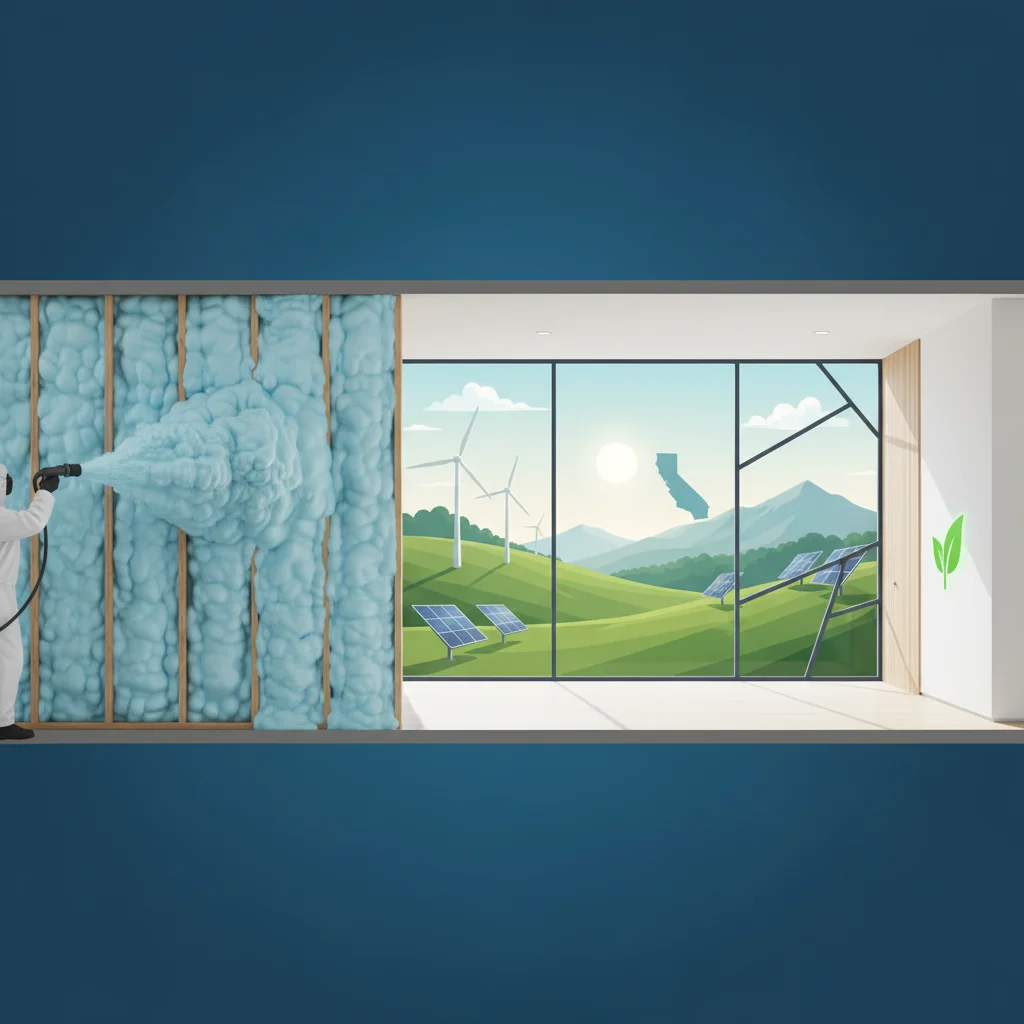
California utility bills climbed 18% between 2024 and 2026, pushing average annual cooling costs past $1,200 in the Central Valley. Homeowners with poorly insulated attics lose up to 40% of their conditioned air through ceilings alone. And spray foam insulation rebates in California now cover $800 to $3,000 of the installation cost, making airtight attic sealing financially accessible for the first time in a decade.
What Are the Current Spray Foam Insulation Rebates Available in California?
California's 2026 spray foam insulation rebates operate through three primary channels: investor-owned utility programs (PG&E, SCE, SDG&E), federal IRA tax credits covering 30% of material and labor costs, and regional air quality districts offering bonus incentives for low-emission spray foam formulations. PG&E's Energy Upgrade California program provides flat rebates of $800 for closed-cell spray foam in attics exceeding R-30 thermal resistance. Southern California Edison's Home Energy Improvement Rebate pays $1.20 per square foot for spray foam applications in climate zones 9-15, capped at $2,500 per household.
The federal Energy Efficient Home Improvement Credit (Section 25C) ended for property placed in service after December 31, 2025 (IRS FS-2025-05). Federal tax credits for this work have ended, but state, local and utility rebates may still apply; check what is available at your address with the DuloCore rebate calculator. San Joaquin Valley Air Pollution Control District adds $500 bonuses for low-GWP (global warming potential) spray foam products using HFO blowing agents instead of traditional HFC formulations. But rebate stacking rules vary—PG&E and federal credits combine freely, while some municipal programs prohibit dual-dipping with utility rebates.
How Much Money Can You Save With California Spray Foam Insulation Rebates?
A typical 1,800-square-foot California home installing closed-cell spray foam in an uninsulated attic pays $4,500 to $7,200 for materials and contractor labor. Combining PG&E's $800 rebate with the federal 30% IRA credit ($1,350-$2,160 on a $4,500-$7,200 project) cuts net costs to $2,350-$4,240. Annual energy savings average $420-$680 in cooling-dominated climates like Fresno and Sacramento, producing a payback period of 3.5 to 6.2 years before rebates, and 2.8 to 4.5 years after incentives.
Homeowners in coastal zones with moderate climates see smaller absolute savings—$280-$380 annually—but still recover spray foam investments within 6-9 years due to lower installation costs for smaller attic areas. Southern California Edison territory residents applying $1.20/sq ft rebates to 1,500-square-foot attic projects receive $1,800 in utility incentives, compressing payback timelines by 14-18 months. So a Riverside homeowner spending $5,400 on spray foam nets $1,800 (SCE) + $1,620 (federal 30%) = $3,420 in combined rebates, reducing project cost to $1,980 with a 3.2-year payback at $620 annual savings.
And low-income households qualifying for Energy Savings Assistance programs through utilities receive 100% coverage for spray foam upgrades in eligible zones, eliminating upfront costs entirely. CARE (California Alternate Rates for Energy) participants save an additional 20% on post-upgrade electricity bills through tiered rate discounts.
What Are the Eligibility Requirements for California Spray Foam Rebate Programs?
California utility rebates require contractor installation by licensed C-2 (insulation) or C-61/D-64 (limited specialty) professionals registered in the utility's trade ally network. PG&E mandates pre-approval applications submitted before project start dates, with energy audits documenting existing R-values below R-19 in attics or R-13 in crawlspaces. Southern California Edison accepts post-installation applications within 180 days of completion but requires photos showing spray foam thickness measurements and thermal imaging scans confirming air seal integrity.
Federal IRA credits demand Energy Star–certified products meeting minimum R-values: R-49 for attics in climate zones 1-3, R-38 for zones 4-8. And the insulation must be installed in the taxpayer's primary residence—vacation homes and rental properties don't qualify unless the owner occupies the unit as their main home. Spray foam formulations using HFC-245fa or HFC-365mfc blowing agents became ineligible for federal credits in January 2026 due to EPA SNAP (Significant New Alternatives Policy) restrictions, so contractors must use HFO-1234ze or water-blown systems.
But income limits don't apply to standard utility rebates—PG&E, SCE, and SDG&E programs serve all residential customers regardless of household earnings. Air district bonuses for low-GWP foam require third-party certification proving global warming potential below 150, submitted with rebate applications. So a San Jose homeowner using Icynene ProSeal Eco (HFO-blown, GWP 1) qualifies for both PG&E's $800 rebate and Bay Area Air Quality Management District's $300 low-emissions bonus.
What Is the Deadline for Applying for California Spray Foam Insulation Rebates?
PG&E's 2026 Energy Upgrade California program accepts applications through December 31, 2026, with funds allocated on a first-come, first-served basis until the $47 million annual budget depletes. Southern California Edison's Home Energy Improvement Rebate operates on a rolling fiscal year from April 1, 2026, to March 31, 2027, but historically exhausts funding by November in high-demand territories like Riverside and San Bernardino counties. San Diego Gas & Electric extends its spray foam incentive through June 30, 2027, under a two-year program cycle with $12 million reserved for insulation upgrades.
Form 5695 only covers qualifying work completed by December 31, 2025 and claimed on a 2025 return; the federal 25C and 25D credits ended after that date (IRS FS-2025-05). The federal Energy Efficient Home Improvement Credit (Section 25C) ended for property placed in service after December 31, 2025 (IRS FS-2025-05). But utility rebates can terminate mid-year when budgets run dry—SCE's 2025 program closed on October 18 after processing 14,200 applications.
Post-installation applications typically face 90- to 180-day submission deadlines from project completion dates. PG&E requires final paperwork within 90 days of the contractor's certificate of completion, while SDG&E allows 180 days for homeowners to gather invoices, thermal imaging reports, and R-value certifications. So a homeowner finishing spray foam installation on March 15, 2026, must submit PG&E applications by June 13, 2026, but has until September 11, 2026, for SDG&E filings.
How Do You Apply for Spray Foam Insulation Rebates in California?
PG&E applications start at the Energy Upgrade California online portal, where homeowners create accounts, enter property addresses, and upload pre-installation energy audit reports showing existing attic R-values below program thresholds. Contractors registered as PG&E trade allies submit project proposals with material specifications (closed-cell vs. open-cell foam, R-value targets, square footage) and cost estimates. After pre-approval, installers complete work and upload post-installation photos documenting foam thickness, coverage area, and thermal imaging scans confirming air barrier continuity.
Southern California Edison accepts direct homeowner applications through the My Account dashboard, requiring contractor invoices, manufacturer spec sheets proving Energy Star compliance, and signed attestations confirming the property serves as the applicant's primary residence. And SCE processes rebates within 6-8 weeks of complete submissions, issuing checks to the homeowner's mailing address or depositing funds directly into linked bank accounts. But incomplete applications—missing thermal imaging, unclear R-value documentation, or non-licensed contractors—face rejection rates near 22%, adding 4-6 weeks to resubmission timelines.
Federal IRA credits require zero pre-approval. Form 5695 only covers qualifying work completed by December 31, 2025 and claimed on a 2025 return; the federal 25C and 25D credits ended after that date (IRS FS-2025-05). The credit directly reduces tax liability dollar-for-dollar—a $6,000 spray foam project generates a $1,800 credit, cutting a $5,000 tax bill to $3,200. So taxpayers owing less than the credit amount can't receive refunds for the excess, but unused credits roll forward to the next tax year under IRA carryover provisions.
Use the free rebate calculator to estimate your combined utility and federal incentive amounts based on attic square footage and climate zone.
How Do California Spray Foam Rebates Compare to Other Insulation Incentives?
California's $800-$2,500 utility rebates for spray foam exceed fiberglass batt incentives by 40-60%—PG&E pays $500 for blown fiberglass attic upgrades versus $800 for closed-cell spray foam. The federal Energy Efficient Home Improvement Credit (Section 25C) ended for property placed in service after December 31, 2025 (IRS FS-2025-05). Basic fiberglass installations often fall short of Energy Star minimum R-values in California's climate zones, disqualifying them from tax benefits. Cellulose insulation rebates match spray foam dollar-for-dollar in PG&E territory ($800 flat rate), but cellulose doesn't provide the air-sealing properties that reduce infiltration losses by 30-50%.
Rigid foam board incentives lag behind—SDG&E offers $0.80 per square foot for exterior wall foam sheathing, compared to $1.20/sq ft for spray foam through SCE programs. But rigid foam applications typically cover smaller surface areas (400-800 sq ft for walls) versus 1,200-2,000 sq ft for attic spray foam, resulting in lower total rebate amounts. So a homeowner insulating 600 sq ft of exterior walls with rigid foam receives $480 (SDG&E) versus $1,920 for spray-foaming a 1,600 sq ft attic at SCE's $1.20/sq ft rate.
Reflective barrier and radiant foil rebates disappeared from California utility portfolios in 2025 after DOE studies showed minimal thermal performance improvements in climate zones with low winter heating demands. And mineral wool batts qualify for standard $500-$650 rebates but cost 15-25% more per square foot than fiberglass while delivering similar R-values, making spray foam's superior air-sealing capability a better value at comparable rebate levels.
Check current heat pump rebates to combine HVAC and insulation upgrades for maximum energy savings and incentive stacking.
Official Sources
- DOE Home Energy Rebates — Federal guidance on IRA tax credits and state-administered rebate programs for insulation and efficiency upgrades. (note: the federal 25C and 25D credits ended for projects completed after December 31, 2025)
- DSIRE California Incentives — Comprehensive database tracking utility rebates, state programs, and air quality district bonuses for spray foam insulation.
- Energy Star Insulation Requirements — Minimum R-value standards by climate zone for federal tax credit eligibility. (note: the federal 25C and 25D credits ended for projects completed after December 31, 2025)
Related Reading: Learn more about Insulation Rebates For Mobile Homes and Insulation Rebates Fresno.
Related Reading: Learn more about Spray Foam Insulation Rebates.
Frequently Asked Questions
Are spray foam insulation rebates available in California?
Spray foam insulation rebates operate through California investor-owned utilities (PG&E, SCE, SDG&E) offering $800-$2,500 for attic and crawlspace applications, federal IRA tax credits covering 30% of project costs through 2032, and regional air quality districts providing $300-$500 bonuses for low-GWP foam formulations. PG&E serves Northern and Central California, SCE covers Southern California excluding San Diego, and SDG&E handles San Diego County territories. And municipal utilities like SMUD (Sacramento) and LADWP (Los Angeles) run separate programs with $600-$1,000 flat rebates for spray foam upgrades meeting Energy Star R-value thresholds.
What is the maximum rebate amount for spray foam insulation in California?
Maximum combined rebates reach $5,660 for a $7,200 spray foam project in Southern California Edison territory: $2,500 (SCE utility rebate at $1.20/sq ft cap) + $2,160 (federal 30% IRA credit) + $500 (air district low-GWP bonus) + $500 (local municipal add-on in select cities like Palm Springs). But typical single-family homes receive $2,150-$3,960 combining utility and federal incentives on $4,500-$7,200 projects. And low-income households qualifying for Energy Savings Assistance programs receive 100% project coverage with no dollar caps, averaging $5,800-$8,200 in free spray foam installations for eligible participants.
Do I need a licensed contractor to qualify for spray foam insulation rebates?
California utility rebates require installation by state-licensed C-2 (insulation contractor) or C-61/D-64 (limited specialty insulation) professionals registered in the utility's trade ally network and carrying minimum $1 million general liability insurance. Federal IRA tax credits don't mandate contractor licensing but require Energy Star–certified products and professional installation meeting manufacturer specifications—DIY spray foam applications forfeit the 30% credit. And PG&E, SCE, and SDG&E reject rebate applications showing unlicensed installers or owner-performed work, even if thermal performance meets program R-value standards. So homeowners must hire credentialed contractors to access both utility rebates and federal tax benefits.
What is the deadline to apply for California spray foam insulation rebates?
PG&E's 2026 program accepts applications through December 31, 2026, but exhausts funding by late October in high-demand regions based on historical depletion patterns. Southern California Edison's fiscal year runs April 1, 2026, to March 31, 2027, with applications closing when the $38 million budget depletes—typically November in Inland Empire territories. The federal Energy Efficient Home Improvement Credit (Section 25C) ended for property placed in service after December 31, 2025 (IRS FS-2025-05). And post-installation paperwork faces 90-day deadlines (PG&E) or 180-day windows (SDG&E) from contractor completion certificates, with late submissions forfeiting rebate eligibility.
How does spray foam insulation compare to other insulation types for California rebates?
Spray foam rebates ($800-$2,500) exceed fiberglass batt incentives ($500-$650) by 40-60% across California utilities due to superior air-sealing performance reducing infiltration losses by 30-50%. Cellulose insulation matches spray foam rebate amounts in PG&E territory ($800 flat rate) but requires separate air-sealing work costing $400-$800, negating the price advantage. The federal Energy Efficient Home Improvement Credit (Section 25C) ended for property placed in service after December 31, 2025 (IRS FS-2025-05). Rigid foam board receives lower per-square-foot rebates ($0.80 vs. $1.20 for spray foam) and covers smaller areas, reducing total incentive dollars. So spray foam delivers the highest combined utility and federal rebate value among insulation options for California homeowners completing attic or crawlspace upgrades.
Ready to find your spray foam insulation rebates? Use our rebate calculator to get personalized incentive estimates based on your utility provider, climate zone, and project size. Get instant calculations for utility rebates, federal tax credits, and air district bonuses—then connect with licensed contractors in your area to start saving.
Updated: April 14, 2026 — fact-checked by DuloCore Research. About our editorial process.
Check your California insulation rebate eligibility — see the programs you qualify for and the dollar amounts on our California insulation rebate finder.